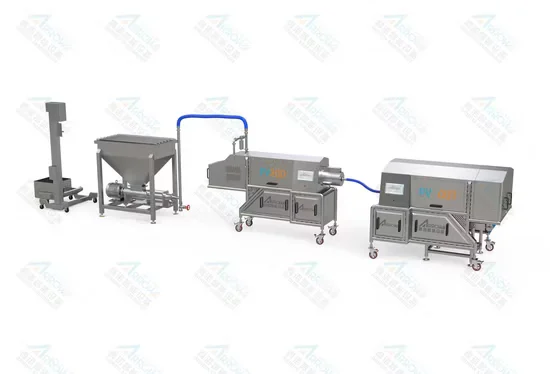
In pet food production, uneven mixing or excessive batch times do more than just slow down the line; they create quality fluctuations in the final extruded or baked products that can ruin a brand’s reputation. A twin-shaft paddle mixer is often the critical equipment choice to break this bottleneck, ensuring consistent dough quality before it reaches the extruder.
The core advantage of this technology lies in its ability to achieve high uniformity in a short time through dual-axis counter-rotation. By creating an intense, fluidized mixing action, it handles heavy liquid additions and complex recipes without forming lumps, thereby safeguarding the throughput and product consistency of the entire processing line.
The Mechanics of Rapid and Uniform Blending
The efficiency of a twin-shaft paddle mixer stems from its mechanical design, which differs significantly from traditional single-shaft or ribbon systems. Two horizontal shafts rotate in opposite directions, each fitted with angled paddles that overlap in the center of the trough. This configuration generates a complex flow pattern where materials are lifted, thrown, and sheared simultaneously.
Unlike simple tumbling actions, this counter-rotating motion creates a fluidized state within the powder or meal bed. The overlapping paddles ensure that every particle is subjected to multiple directional forces, promoting three-dimensional movement rather than just circular rotation. This intense agitation allows for rapid dispersion of minor ingredients, such as vitamins and minerals, throughout the bulk material.
The specific angle of the paddles is engineered to balance mixing intensity with material handling gentleness. While the action is vigorous enough to break up small agglomerates, it avoids the excessive heat generation or particle degradation associated with high-speed impellers. For pet food manufacturers, this means achieving a homogeneous blend in minutes rather than the longer cycles required by less aggressive mixing technologies, directly impacting the overall cycle time of the batch process.
Maximizing Throughput and Ingredient Consistency
One of the primary concerns for production directors is maintaining a steady flow of material to the extruder. If the mixing stage cannot keep pace with the downstream equipment, it becomes a bottleneck that forces the extruder to idle or run intermittently. A fast-mixing pet food mixing equipment solution eliminates this constraint by reducing batch cycle times significantly.
When the mixer discharges quickly and consistently, the upstream grinding and weighing systems can operate at their optimal capacity. This synchronization is vital for large-scale kibble or treat production lines where even minor delays accumulate into hours of lost production over a week. The ability to process batches rapidly ensures that the extrusion system receives a continuous, uniform feed, which is essential for stable pressure and temperature profiles during cooking.
Beyond speed, uniformity is non-negotiable for nutritional compliance and product quality. Inconsistent distribution of micro-ingredients can lead to spots of high concentration or deficiency in the final pellets. The high shear and thorough folding action of the twin-shaft design ensure that even trace additives are evenly distributed. This consistency is particularly important when producing premium formulas where every kibble must meet strict nutritional specifications.
Gentle Handling and Hygienic Design for Complex Recipes
Modern pet food formulations often include fresh meat, high levels of fat, or heat-sensitive functional ingredients. Traditional mixers may struggle with these components, leading to clumping or excessive temperature rise due to friction. The twin-shaft paddle mixer addresses these challenges through its low-speed, high-torque operation.
The gentle yet thorough mixing action minimizes mechanical damage to delicate ingredients, such as whole grains or structured protein meals. More importantly, it manages heat buildup effectively. Since the mixing time is short and the rotational speed is moderate, the temperature increase of the material is negligible. This is crucial for preserving the integrity of enzymes, probiotics, or other bio-active additives that might be deactivated by excessive heat during prolonged mixing.
Hygiene and cleaning are equally critical, especially for facilities producing multiple SKUs or switching between allergen-containing and free-from formulas. The design typically features a full-length discharge door that opens completely, allowing for rapid emptying and minimal residue retention. The absence of dead corners in the trough and the smooth surface finish of the paddles reduce the risk of cross-contamination. This ease of cleaning supports faster changeovers, enabling manufacturers to respond flexibly to market demands without compromising safety standards.
Comparative Analysis: Twin-Shaft vs. Single-Shaft and Ribbon Mixers
Selecting the right mixer requires understanding how different technologies perform under specific operational conditions. While ribbon mixers and single-shaft paddle mixers have their place, the twin-shaft paddle mixer offers distinct advantages for high-capacity and complex pet food applications.
| Feature | Twin-Shaft Paddle Mixer | Single-Shaft Paddle Mixer | Ribbon Mixer |
|---|---|---|---|
| Mixing Time | Very Fast (2-4 mins typical) | Moderate | Slow (10-20 mins) |
| Uniformity (CV) | High (<5%) | Good | Variable |
| Liquid Addition | Excellent (handles high % easily) | Good | Limited (risk of balling) |
| Residue/Discharge | Low (full opening door) | Moderate | Higher (end discharge) |
| Best For | High throughput, wet mixes, frequent changes | Standard dry blends, lower budget | Simple dry powders, low shear needs |
Ribbon mixers rely on a helical screw to move material, which can be slow and may leave significant residue at the ends of the trough. They are suitable for simple dry blends but struggle with high-fat or high-moisture additions, often forming balls of material that require extended mixing times to break down. Single-shaft paddle mixers improve on this but lack the intense counter-current action of the twin-shaft design, resulting in longer mixing cycles and potentially lower uniformity for difficult recipes.
The twin-shaft paddle mixer excels in scenarios requiring rapid integration of liquids, such as fresh meat slurries or fat coatings, without forming agglomerates. Its ability to handle high loading coefficients while maintaining short cycle times makes it the preferred choice for modern, high-efficiency pet food and aquafeed plants.
Integrating the Mixer into Your Production Line
Proper integration of the mixing system is essential for realizing its full potential. In a typical dry pet food or treat line, the mixer is positioned after the grinding and weighing stages and before the extruder or forming machine. It serves as the buffer and homogenization point where all dry and liquid ingredients are combined into a uniform dough or meal.
For wet food or high-meat recipes, the mixer must be compatible with liquid addition systems that can inject fats, broths, or slurries precisely during the mixing cycle. The control system should allow for synchronized operation with upstream feeders and downstream conveyors to ensure a smooth flow of material. Automation plays a key role here, with sensors monitoring load cells and motor torque to determine the optimal mixing end-point based on the specific recipe.
When planning a new facility or upgrading an existing one, it is important to consider the footprint and utility requirements of the mixer. The equipment should be sized to match the capacity of the extruder to avoid bottlenecks. Engineering support can help determine the ideal configuration, ensuring that the mixer’s discharge rate aligns with the feed hopper of the extruder. This holistic approach ensures that the entire line operates as a cohesive unit, maximizing efficiency and product quality.
Frequently Asked Questions
Q: What is the typical mixing time for a twin-shaft paddle mixer in pet food production?
A: Mixing times typically range from 2 to 4 minutes per batch, depending on the formulation complexity and desired uniformity. This is significantly faster than ribbon mixers, which may take 10 to 20 minutes. The short cycle time helps maintain high throughput and ensures consistent quality for continuous extrusion processes.
Q: Can a twin-shaft paddle mixer handle high-meat or high-moisture pet food recipes?
A: Yes, this mixer is well-suited for recipes with high liquid or fresh meat content. The counter-rotating paddles create a fluidized mixing action that disperses liquids evenly without forming lumps or agglomerates. This capability is essential for producing high-quality wet food chunks or high-meat inclusion dry kibble without compromising texture.
Q: How do you prevent cross-contamination when switching between different pet treat formulas?
A: The design features a full-length discharge door and smooth internal surfaces that minimize residue retention. Quick and thorough cleaning is facilitated by easy access to the mixing chamber. For sensitive switches, a dedicated cleaning protocol can be implemented, and the mixer’s efficient discharge ensures minimal material remains between batches, reducing the risk of cross-contamination.
Q: What is the maximum loading capacity for industrial twin-shaft paddle mixers?
A: Loading capacity varies by model but generally allows for a high fill factor, often up to 70-80% of the total volume, without compromising mixing efficiency. The exact capacity depends on the bulk density of the ingredients and the specific power rating of the drive system. It is important to select a model that matches your required batch size and hourly throughput.
Send your pet food formula and target capacity to receive a customized mixing section technical proposal and equipment layout diagram. Our engineering team can also discuss raw material trials to verify performance with your specific ingredients before finalizing the equipment configuration.