While often grouped together as “meat snacks,” meat strips and jerky require fundamentally different moisture targets and extrusion shear profiles to achieve their distinct textures. Misidentifying these boundaries during the equipment selection phase frequently leads to production bottlenecks, particularly in the drying section, where capacity mismatches can compromise product consistency and shelf stability.
The core distinction lies in the final moisture content and the mechanical treatment of protein structures. Meat strips typically retain higher moisture for a soft, flexible chew, relying on precise thermal control during extrusion to bind ingredients without excessive dehydration. Jerky, conversely, demands a dense, fibrous texture achieved through lower moisture removal and specific forming techniques that preserve muscle fiber integrity. Selecting the correct Meat strips vs jerky lines configuration ensures that the extruder, dryer, and coating systems work in harmony rather than as isolated units.
Defining the Texture Gap: Moisture and Binding Requirements
Understanding the end-product specification is the first step in designing a reliable processing line. Meat strips are characterized by their pliability and higher residual moisture, which requires careful management of water activity to prevent microbial growth while maintaining a soft bite. This product category often utilizes high ratios of fresh meat or meat slurries, demanding equipment that can handle viscous, high-fat formulations without clogging or inconsistent feeding.
Jerky presents a different challenge. The goal is a firm, chewy texture that mimics traditional air-dried meat. This requires a process that aligns protein strands and removes moisture gradually to avoid case hardening, where the exterior dries too quickly and traps moisture inside. The binding mechanism in jerky relies less on starch gelatinization and more on protein denaturation and mechanical alignment. Therefore, the process parameters for Meat strips vs jerky lines must diverge significantly at the forming and drying stages to meet these distinct textual goals.
When evaluating suppliers, it is crucial to discuss how their equipment handles these specific moisture targets. A system designed for high-starch kibble will not necessarily perform well for high-meat snacks. The engineering team should assess your raw material behavior, such as the viscosity of fresh meat inputs, to recommend the appropriate screw configuration and thermal profile. This ensures that the final product meets both sensory expectations and safety standards for water activity.
Extrusion Shear and Forming for Meat Strips
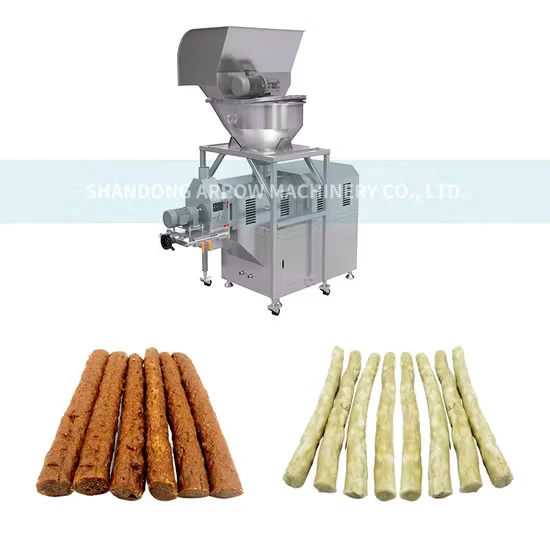
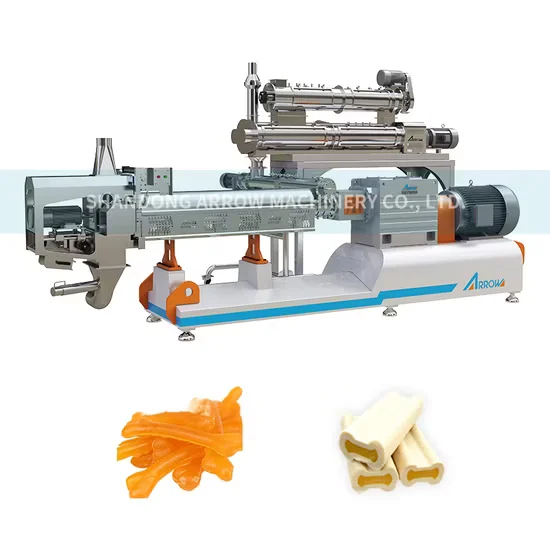
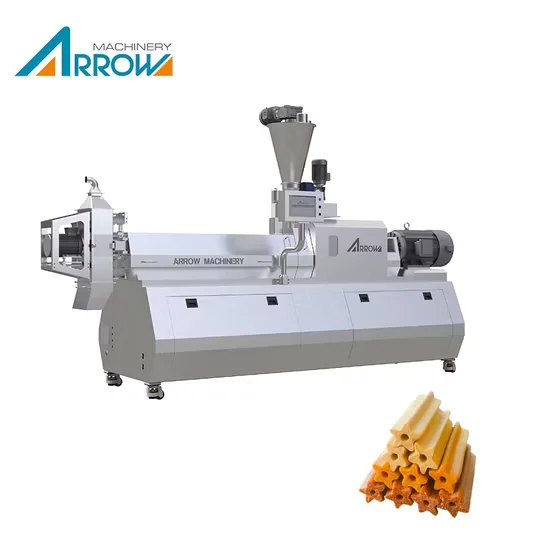
Producing uniform meat strips requires an extruder capable of managing high-shear mixing while maintaining temperature control to prevent premature protein coagulation. Twin-screw extruders are particularly effective here because they offer superior conveying efficiency and mixing homogeneity for sticky, high-fat doughs. The intermeshing screws provide a self-wiping action that prevents material buildup, ensuring consistent output even when processing formulations with significant fresh meat content.
The die design plays a critical role in defining the strip profile. Unlike round kibble, strips require flat or rectangular dies that maintain structural integrity as the product exits the barrel. The cutting mechanism must be synchronized with the extrusion speed to ensure uniform length and weight. If the shear heat is too high, the proteins may over-cook, resulting in a brittle texture rather than the desired flexible chew. Therefore, precise control over barrel temperature zones and screw speed is essential.
For facilities planning Meat strips vs jerky lines, the choice of extruder directly impacts downstream efficiency. A well-configured twin-screw system can produce a homogeneous matrix that dries evenly, reducing the risk of uneven moisture distribution. This is vital for maintaining product quality and extending shelf life. The ability to adjust screw elements allows operators to fine-tune the residence time and shear intensity, adapting to different recipes without major hardware changes.
Low-Temperature Processing for Jerky Production
Jerky production benefits from low-temperature processing methods that preserve the natural structure of meat proteins. Low-temperature cold extruders are designed to form the product with minimal thermal input, avoiding the expansion and puffing associated with standard pet food extrusion. This gentle handling helps maintain the dense, fibrous texture that consumers expect from jerky snacks. The focus shifts from starch gelatinization to protein alignment and binding.
In this context, the extruder acts primarily as a forming device rather than a cooker. The mechanical energy input is carefully controlled to mix ingredients and shape the dough without generating excessive heat. This approach preserves the nutritional integrity of the meat and allows for the inclusion of sensitive ingredients that might degrade under high temperatures. The resulting product has a compact structure that responds predictably to subsequent drying processes.
When comparing Meat strips vs jerky lines, the thermal profile of the extrusion stage is a key differentiator. Jerky lines prioritize minimal heat generation during forming, while meat strip lines may use moderate heat to aid in binding and initial moisture reduction. Understanding this distinction helps in selecting the right machine series. For example, a low-temperature cold extruder is ideal for jerky, whereas a standard twin-screw extruder with precise temperature control may be better suited for meat strips that require some degree of cooking.
Drying Strategies to Lock in Shelf Stability
Drying is often the bottleneck in snack production lines, and its configuration must match the specific moisture removal requirements of the product. Cross-flow circulation dryers are commonly used for their ability to provide uniform air distribution across multiple trays or belts. For meat strips, the goal is to remove surface moisture quickly while allowing internal moisture to migrate outward without causing shrinkage or cracking. This requires a balanced approach to air temperature, humidity, and velocity.
Jerky drying is a slower, more gradual process. Rapid drying can lead to case hardening, where the outer layer becomes tough and impermeable, trapping moisture inside and creating a risk of spoilage. Therefore, jerky lines often employ multi-stage drying protocols with controlled humidity levels. The dryer must be capable of maintaining consistent conditions over extended periods to ensure that every piece reaches the target water activity. Matching the dryer capacity to the extruder output is critical to avoid bottlenecks.
In projects involving Meat strips vs jerky lines, the drying section often requires the most careful engineering. A dryer that is undersized for the moisture load of high-meat formulations will struggle to achieve consistent results. Conversely, an oversized dryer may waste energy and occupy unnecessary floor space. By mapping the entire thermal profile from mixing to drying, engineers can specify a system that balances throughput with product quality. This holistic view prevents the common issue of having a high-capacity extruder paired with an inadequate dryer.
Frequently Asked Questions
Q: Can the same twin-screw extruder produce both meat strips and jerky?
A: While a twin-screw extruder can physically process both, the operating parameters and screw configurations differ significantly. Meat strips may require higher shear and temperature for binding, while jerky benefits from low-temperature forming to preserve texture. Switching between these products often requires adjusting screw elements, die plates, and process settings. It is advisable to consult with engineers to determine if a single machine can meet both needs efficiently or if dedicated lines are preferable.
Q: What is the ideal moisture content difference between meat strips and jerky?
A: Meat strips typically retain higher moisture levels, often ranging between 20% to 30%, to maintain a soft and flexible texture. Jerky, on the other hand, is dried to a lower moisture content, usually below 20%, to achieve a firm, chewy consistency and ensure shelf stability. The exact targets depend on the specific recipe and desired water activity. Precise control during drying is essential to meet these specifications without compromising product quality or safety.
Q: How does the drying time change when switching from strips to jerky?
A: Drying time for jerky is generally longer than for meat strips due to the need for gradual moisture removal to prevent case hardening. Meat strips can often be dried more quickly because their higher initial moisture and softer structure allow for faster surface evaporation. Jerky requires a slower, controlled drying process to ensure uniform moisture migration from the center to the surface. This difference necessitates adjustable dryer settings and potentially different residence times.
Q: Do meat strips require a different die design compared to jerky?
A: Yes, die design influences the final shape and texture. Meat strips often use flat or rectangular dies to create uniform, flexible profiles. Jerky may utilize dies that promote a denser, more fibrous structure, sometimes with specific geometries to enhance chewiness. The choice of die affects how the product expands or retains its shape upon exiting the extruder. Selecting the appropriate die is crucial for achieving the desired visual and textural attributes for each snack type.
Send your specific formula details and target hourly capacity to receive a customized equipment selection plan. Our engineering team can provide a detailed factory layout and technical specifications tailored to your production goals. Discuss whether your project requires standalone machines or a fully integrated turnkey solution, including options for raw material trials to validate process performance before finalizing your order.