Many pet food manufacturers discover a harsh reality after the equipment arrives: without systematic training, operators often struggle with parameter fluctuations and increased energy consumption. A structured pet food line operator training program is essential to minimize this commissioning risk and ensure stable output from day one.
Comprehensive post-delivery training goes beyond basic button-pushing. It covers process parameter adjustment, preventive maintenance protocols, and troubleshooting logic. This approach ensures that your team can maintain consistent kibble quality and extend equipment life, rather than relying constantly on external support for minor adjustments.
On-Site Commissioning and Hands-On Operation Basics
Shipping machinery is only half the job. The real challenge begins when the power is turned on. I recall a dry kibble project where night shift operators kept tweaking the feeder speed without adjusting the steam valve, causing a massive dough block in the pre-conditioner. They simply did not understand the basic interlocking logic. Flying out from our Jinan factory to clear that mess taught me that hands-on field training covering proper start-up, shutdown, and screw configuration changes is what actually keeps a pet food line running smoothly.
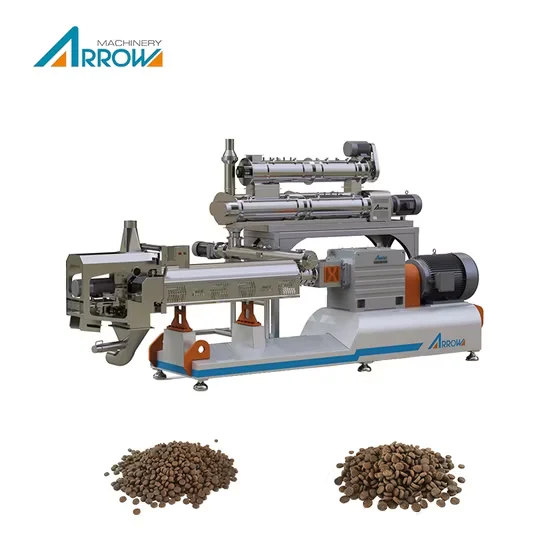
During on-site commissioning, our engineers focus on the specific workflow of your facility. For a Twin-Screw Extruder, this means demonstrating the correct sequence for heating barrels, introducing raw materials, and managing pressure buildup. Operators learn to recognize the sound and vibration signatures of a healthy machine versus one under stress. Safety norms are reinforced through practical drills, ensuring that every team member knows how to respond to emergency stops or blockages without damaging the screw elements.
The training also extends to downstream equipment. A Cross-Flow Circulation Dryer requires precise air volume and temperature management to avoid case hardening or uneven moisture removal. Similarly, a Vacuum Coating Machine demands careful synchronization between the coating drum rotation and the vacuum pump operation. By practicing these steps under supervision, operators gain the confidence to manage the entire line, from ingredient intake to final packaging, reducing the likelihood of costly downtime due to human error.
Process Parameter Adjustment for Consistent Kibble Quality
Consistency is the hallmark of a professional pet food brand. However, achieving uniform pellet size, density, and moisture content requires more than just setting a recipe. It demands a deep understanding of how raw materials behave under heat and shear. During pet food line operator training, we teach your process engineers how to adjust screw speed, barrel temperature profiles, and cutter velocity based on real-time product characteristics.
For instance, when producing high-meat-content kibble, the formulation behaves differently than standard cereal-based mixes. Operators must learn to balance the steam injection in the pre-conditioner to ensure adequate cooking without creating a slurry that clogs the die. If the pellets emerge too dense or lack expansion, the training covers how to tweak the shear force by changing screw configurations or adjusting the moisture content before extrusion. This empirical knowledge is critical for maintaining product quality across different batches.
Moisture control is another pivotal skill. After extrusion, the product enters the drying phase. Operators are trained to monitor the inlet and outlet air temperatures of the dryer and adjust the residence time accordingly. If the kibble is too brittle, it may indicate over-drying; if it feels soft or sticks together, the moisture target has not been met. By understanding these cause-and-effect relationships, your team can make proactive adjustments rather than reactive fixes, ensuring that every bag meets your quality standards.
Routine Maintenance and Troubleshooting Protocols
Preventive maintenance is far cheaper than emergency repairs. A well-structured training module includes detailed protocols for daily, weekly, and monthly checks. For the grinding system, this involves inspecting hammer mill screens for wear and ensuring that particle size remains consistent. In the mixing section, operators learn to check paddle mixers for residue buildup that could lead to cross-contamination between batches. These routine tasks are simple but vital for long-term equipment health.
Troubleshooting skills are developed through scenario-based learning. What do you do if the extruder motor trips? Is it a mechanical jam or an electrical overload? How do you clear a blocked die without damaging the precision-machined holes? Our engineers walk your maintenance team through these common issues, providing a logical framework for diagnosis. This reduces the mean time to repair (MTTR) and keeps production schedules on track.
| Equipment Component | Daily Check | Weekly Maintenance | Monthly Inspection |
|---|---|---|---|
| Twin-Screw Extruder | Check oil levels, listen for unusual noise | Inspect die plate for wear, clean pre-conditioner | Verify screw element alignment, check heater bands |
| Cross-Flow Dryer | Clean air filters, check belt tension | Lubricate bearings, inspect fan blades | Calibrate temperature sensors, check insulation |
| Vacuum Coating Machine | Verify vacuum seal integrity, clean drum | Check pump oil level, inspect spray nozzles | Test vacuum gauge accuracy, clean internal filters |
This structured approach ensures that small issues are caught before they become major failures. By empowering your local team with these skills, you reduce dependency on external service visits for routine matters, allowing your factory to operate with greater autonomy and efficiency.
Digital Manuals and Ongoing Remote Support
Training does not end when our engineers leave your site. We provide comprehensive digital manuals in multiple languages, covering operation, maintenance, and spare parts lists. These documents serve as a reference guide for new hires and a refresher for experienced staff. Access to clear, illustrated instructions helps bridge any language barriers and ensures that safety and operational standards are maintained consistently.
Moreover, Arrow offers ongoing remote support to address questions that arise during regular production. Whether it is a query about a specific error code or advice on optimizing a new recipe, our technical team is available to provide guidance. This continuous support loop ensures that your investment remains productive and adaptable to market changes. Regular follow-ups allow us to share updates on best practices and new techniques that can further enhance your production efficiency.
By combining initial hands-on pet food line operator training with robust digital resources and remote assistance, we ensure that your team is never left alone to face complex challenges. This holistic approach to after-sales support is designed to maximize the lifespan of your equipment and the profitability of your operation.
Frequently Asked Questions
Q: How long does the on-site operator training typically last after equipment delivery?
A: The duration depends on the complexity of the line and the number of operators. Typically, on-site training lasts from one to two weeks. This period covers theoretical explanations, hands-on practice, and supervised production runs. We ensure that both operators and maintenance personnel are comfortable with the equipment before signing off.
Q: Will the training cover both the twin-screw extruder and downstream drying and coating systems?
A: Yes, our training is holistic. We cover the entire production line, including the Twin-Screw Extruder, dryers, grinders, mixers, and coating machines. Understanding how each section interacts is crucial for overall line efficiency. We focus on the integration points, such as how extrusion moisture affects drying time, to ensure smooth workflow.
Q: What happens if our operators need refresher training months after the initial commissioning?
A: We offer remote video support for quick queries and can arrange additional on-site visits if necessary. Refresher courses can be customized to address specific challenges your team may have encountered. Our goal is to build long-term partnerships, so we remain accessible to help you optimize your processes as your business grows.
Q: Are the training manuals and safety guidelines provided in our local language?
A: Yes, we provide documentation in multiple languages, including English, Spanish, Arabic, Portuguese, Russian, and French. This ensures that all your staff can understand the operating instructions and safety protocols clearly. We believe that clear communication is key to safe and efficient factory operations.
Send your pet food formula and target capacity to receive a custom turnkey solution. This package includes a detailed training plan, workshop layout, and technical specifications to help you evaluate the full scope of support before making a decision.