Many overseas buyers hesitate when planning a new pet food factory because their local power grid differs from the manufacturer’s standard. The fear that a 50 Hz machine will fail on a 60 Hz supply, or vice versa, is common but largely manageable with proper engineering.
A pet food production line can operate stably on either 50 Hz or 60 Hz power, provided the electrical components are configured to match the local utility specifications during the procurement phase. This involves selecting appropriate motors, installing variable frequency drives (VFDs), and adjusting control systems to ensure consistent throughput and product quality across extrusion, drying, and coating stages.
Understanding the Core Differences Between 50 Hz and 60 Hz Power
The primary distinction between 50 Hz and 60 Hz power supplies lies in the frequency of the alternating current, which directly influences the rotational speed of AC induction motors. In regions such as Europe, Asia, and Africa, 50 Hz is the standard, while North America and parts of South America and Japan utilize 60 Hz. For industrial machinery, this difference is not merely a label but a fundamental operational parameter. An electric motor designed for 50 Hz will run approximately 20 percent faster if connected directly to a 60 Hz supply without adjustment. This increase in speed can lead to excessive wear, overheating, and altered mechanical performance.
Conversely, running a 60 Hz motor on a 50 Hz supply without compensation causes the motor to run slower and can result in reduced torque and potential overheating due to increased magnetic flux. For a complete production line, these variations affect every rotating component, from feeders and mixers to the main extruder screw and dryer fans. Ignoring these differences during the design phase can lead to significant operational inefficiencies. Therefore, verifying the exact voltage and frequency of the target facility is the first critical step in any international equipment purchase.
How Frequency Affects Key Pet Food Processing Machines
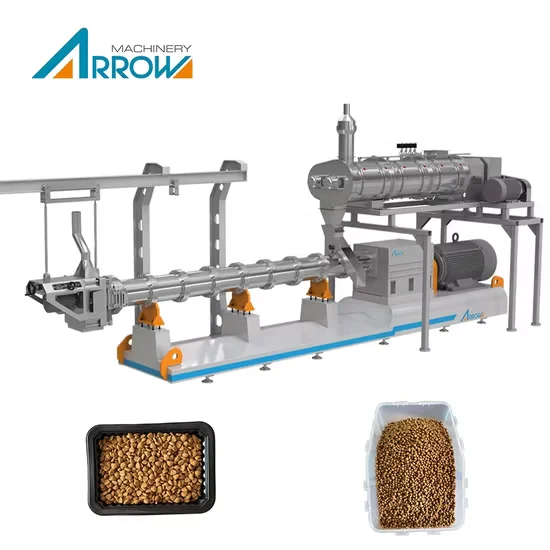
The impact of power frequency is most pronounced in the core processing units where precise speed and torque control are essential for product quality. In a twin-screw extruder, the screw rotation speed determines the shear rate, residence time, and thermal profile of the dough. If the motor runs faster than intended due to a frequency mismatch, the material may be over-sheared, leading to degraded starch structure or burnt product. If it runs slower, the material may not cook sufficiently, resulting in poor expansion and low digestibility. Consistent shear profiles are vital for achieving the desired kibble density and texture.
Downstream equipment is equally sensitive. A cross-flow circulation dryer relies on fans to distribute hot air evenly across the product bed. A change in fan speed alters the airflow volume and pressure, which directly impacts drying efficiency and moisture uniformity. Inconsistent drying can cause case hardening, where the exterior dries too quickly while the interior remains moist, leading to spoilage or cracking during storage. Similarly, in a vacuum coating machine, pump speed and drum rotation must be synchronized to ensure even fat and flavor distribution. Mismatched frequencies can disrupt this balance, causing uneven seasoning and product rejection.
For specialized applications, such as producing floating fish feed or high-meat inclusion kibble, the margin for error is smaller. The buoyancy of aquatic feed depends on precise expansion ratios, which are controlled by extrusion parameters including screw speed and temperature. Any deviation caused by incorrect motor speeds can shift the product from floating to sinking, rendering it unsuitable for the target species. Thus, aligning the pet food line power supply with the machine’s design specifications is not optional but a technical necessity.
Technical Solutions for Adapting Equipment to Your Local Grid
Engineers have developed several reliable methods to adapt industrial machinery to different power frequencies. The most common and effective solution is the use of variable frequency drives (VFDs). A VFD allows the operator to set the exact output frequency required by the motor, regardless of the input supply. This means a motor can be driven at its optimal 50 Hz or 60 Hz speed even if the local grid differs. VFDs also provide soft-start capabilities, reducing mechanical stress on gears and bearings during startup, which extends equipment life.
Another approach is specifying dual-frequency or wide-range motors during the ordering process. These motors are designed with insulation and cooling systems that can handle the thermal loads associated with both 50 Hz and 60 Hz operations. However, even with such motors, the control logic and drive settings must still be configured correctly. In some cases, transformers may be required if the voltage levels also differ, but frequency conversion is primarily handled by the drive electronics rather than passive transformers.
When sourcing a complete line, it is crucial to communicate these requirements early. Suppliers who offer process consultation can integrate these electrical adaptations into the initial design. For instance, ensuring that the PLC control system accounts for the correct motor feedback signals prevents automation errors. By addressing these technical details upfront, buyers avoid costly retrofits and ensure that the extrusion, drying, and coating systems perform as engineered.
What Buyers Must Specify in the Inquiry Stage
To prevent delays and ensure compatibility, buyers must provide detailed electrical specifications when requesting a quotation. This includes the nominal voltage, phase number, frequency, and any known fluctuations in the local grid. It is also important to specify the type of control power available for auxiliary systems. Providing this information allows the engineering team to select the correct motors, drives, and electrical components from the start.
Additionally, clarify whether the scope includes installation and commissioning support. Overseas projects often require coordinated efforts to verify electrical connections and test run parameters on-site. A clear contract that defines these responsibilities helps manage expectations and ensures that any necessary adjustments are made before full-scale production begins. By treating electrical configuration as a core part of the technical specification, investors can secure a production line that delivers consistent quality from day one.
Frequently Asked Questions
Q: Will running a 50 Hz extruder on a 60 Hz power supply damage the motor?
A: Direct connection without adjustment can cause the motor to run 20 percent faster, leading to overheating and excessive wear. However, using a variable frequency drive (VFD) allows you to limit the output to 50 Hz, protecting the motor and maintaining the correct screw speed for your recipe. Always confirm the drive configuration with your supplier.
Q: Do I need a transformer if my factory voltage matches but the frequency is different?
A: A transformer changes voltage, not frequency. If your voltage is compatible but the frequency differs, you need a VFD or a frequency converter, not just a transformer. The VFD will rectify the incoming AC to DC and then invert it back to AC at the desired frequency, ensuring your motors run at the correct speed regardless of the grid.
Q: How does frequency affect the drying time and capacity of a cross-flow dryer?
A: Fan speed is directly linked to frequency. A higher frequency increases airflow, which can reduce drying time but may also cause product blow-off or uneven drying if not balanced. A lower frequency reduces airflow, potentially creating bottlenecks. Proper VFD control ensures the fan operates at the designed speed, maintaining consistent moisture removal and throughput.
Q: Can the control panel (PLC/HMI) operate seamlessly on both 50 Hz and 60 Hz systems?
A: Yes, modern PLCs and HMIs typically use switched-mode power supplies that accept a wide range of input voltages and frequencies. However, the logic programs controlling motor speeds and timers must be set to match the actual operating conditions. Ensuring the software parameters align with the hardware configuration is key to stable automation and accurate process control.
Send your factory’s electrical parameters, including voltage and frequency, along with your target capacity and product formula to receive a customized equipment configuration. Our engineering team can provide detailed technical specifications and layout plans to ensure your production line integrates perfectly with your local utilities.