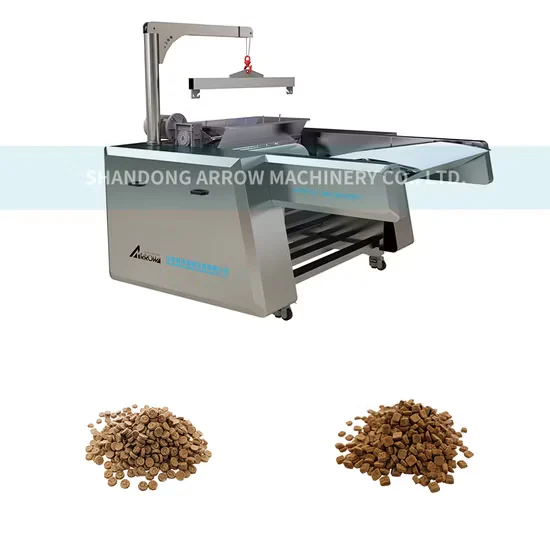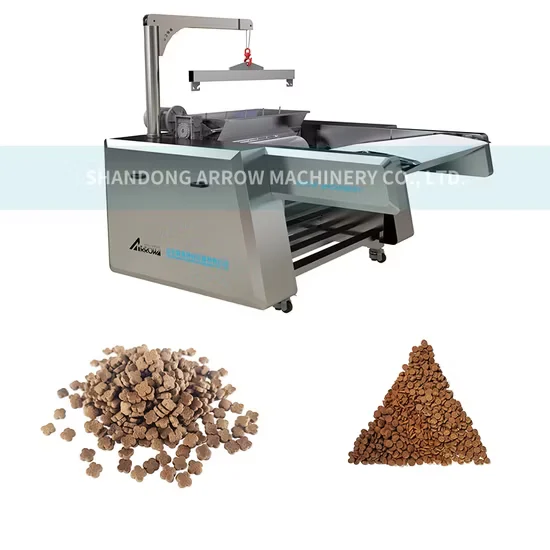


How the Automatic Baked Pet Food Equipment for Dry Cat Works in Your Line
Match formulation to trial — Validate pellet shape and density with your specific meat meal and grain ratios before finalizing the LYE Series configuration.
Technical Specifications
| Parameter | Value |
|---|---|
| Product | LYE Series Twin-Screw Extruder for Dry Pet Food |
| Model | LYE400, LYE1000 |
| Capacity | 500-6000kg/H |
| Main Equipment | Double-Screw Extruder |
| Raw Material | Fish Powder, Born Meal, Corn, Soyabeen |
| Feed Type | Meat and Bone Meal |
| Voltage | 220/380/Customized |
| Material | 304 Stainless Steel |
| Feeder | Loss Weight Type/ Volumetric Feeder |
| Heating Tempeature | Adjustable |
| Feeding Speed | Adjustable |
| Operation | Fully Automatic |
| Power Source | Electric |
| Process | Thermal Processing |
Application Suitability
| Product / Industry | Typical Use |
|---|---|
| Dry Dog Food Manufacturers | Producing standard kibble from meat and bone meal blends using high-capacity thermal processing. |
| Cat Food Production Plants | Manufacturing small-diameter dry pellets with consistent buoyancy and texture for feline diets. |
| Private-Label Contract Processors | Running automated batches of corn and soybean-based formulas with precise feeding control for brand consistency. |
Why Kibble Size Drifts After Two Hours of Running
Consistent pellet quality depends on matching extruder configuration to raw material behavior, not just nominal capacity.
Many factories face a frustrating reality: the lab trial produces perfect kibble, but full-scale production yields uneven particles or poor expansion. This often stems from mismatched thermal profiles or inadequate feeding precision when scaling up. When the extruder cannot maintain stable pressure due to fluctuating ingredient density, the final product suffers from size drift and inconsistent moisture content. Coordinating multiple suppliers for grinding, mixing, and drying often leaves gaps in process control, making it difficult to pinpoint the root cause of quality issues.
Where the LYE Series Fits in Your Process
The LYE Series Twin-Screw Extruder serves as the core forming unit in a dry pet food production line. It receives pre-mixed ingredients from upstream hammer mills and mixers, where particle size and homogeneity are critical. Inside the barrel, the twin-screw mechanism applies shear and heat to cook and shape the dough. The output then moves directly to downstream drying and coating systems. Proper integration ensures that the extruder’s 500-6000kg/H output aligns with the dryer’s moisture removal capacity, preventing bottlenecks.
Navigating Production Challenges
Raw material variability is the primary disruptor in extrusion. Formulas with high fresh meat content or varying levels of fish powder behave differently under heat and pressure. If the feeder cannot compensate for these density changes, the screw fill factor fluctuates, leading to unstable cutting and irregular pellet shapes. High-fat ingredients can also cause slippage inside the barrel, reducing mechanical energy input and affecting starch gelatinization. Maintaining continuous operation requires a system that adjusts heating temperature and feeding speed in real time to counteract these variations.
Understanding Core Specifications
The LYE400 and LYE1000 models utilize a double-screw design that offers superior mixing and conveying efficiency compared to single-screw units. This configuration allows for better handling of diverse raw materials like corn, soyabeen, and bone meal. The adjustable heating temperature enables operators to fine-tune the thermal processing profile, ensuring adequate cooking without burning sensitive nutrients. Choosing between a loss weight type or volumetric feeder depends on the required precision; loss weight feeders provide higher accuracy for complex formulations by continuously monitoring mass flow. The 304 stainless steel construction ensures hygiene and resistance to corrosion from acidic or salty ingredients common in pet food recipes.
The Hidden Costs of Poor Selection
Selecting an extruder based solely on price or nominal horsepower often leads to hidden operational costs. An undersized machine forces continuous overloading, accelerating wear on screws and barrels. Inconsistent output forces downstream dryers to work inefficiently, resulting in uneven moisture levels and potential mold growth in stored kibble. Frequent stoppages for cleaning or adjustment reduce overall plant throughput. When expansion becomes necessary, a poorly integrated standalone unit may require complete replacement rather than simple module addition, wasting initial capital investment.
Why Source This Equipment from Arrow
Arrow provides manufacturer-oriented supply, ensuring that the LYE Series is engineered specifically for pet food applications rather than generic industrial use. The company supports application-based machine selection, analyzing your specific ingredient ratios and target product characteristics before recommending the LYE400 or LYE1000. Raw-material trials allow you to verify performance with your actual formula before commitment. Custom line layouts ensure the extruder integrates smoothly with your existing or planned drying and coating systems. Export project coordination includes factory acceptance testing, providing visibility into equipment performance before shipment. Ongoing process consultation helps optimize parameters for new recipes or capacity changes.
Documentation & Delivery
- Detailed technical specifications sheet listing model-specific parameters and power requirements.
- Plant layout drawings showing footprint and utility connection points for the LYE Series.
- Comprehensive operation and maintenance manuals in English for operator training.
- Factory acceptance test records documenting performance during pre-shipment trials.
- Export packing designed for ocean freight protection with corrosion prevention measures.
- Compliance documents and certificates provided per contract terms and destination requirements.
Installation, Operation & Maintenance
- Ensure concrete foundation meets load requirements for the LYE400 or LYE1000 main unit.
- Connect 220/380V customized power supply and verify grounding for safe automatic operation.
- Conduct initial trial runs with water or soft material to check screw rotation and feeder calibration.
- Clean barrel and die plate thoroughly after each shift to prevent residue buildup and contamination.
- Replace worn screw elements and barrel liners based on inspection schedules to maintain efficiency.
- Adjust heating zones and feeding speed when switching between corn-heavy and meat-heavy formulas.
Request a Configuration Quote
To receive an accurate proposal, specify your target product type, such as dry dog kibble or cat food. Provide raw material formulations, including estimated ratios of meat meal, fish powder, and grains. Define your required output capacity in kg/h and desired pellet shape and size. Share your factory dimensions, available voltage, and heat source details. Our engineering team will respond with a tailored configuration, layout options, and a formal quotation for the LYE Series extruder.
Frequently Asked Questions
Q: What raw materials can this extruder process?
A: The LYE Series handles fish powder, bone meal, corn, and soyabeen effectively. It is designed for meat and bone meal-based formulations typical in dry pet food. The twin-screw mechanism ensures thorough mixing and cooking of these diverse ingredients.
Q: How do I choose between LYE400 and LYE1000 models?
A: Selection depends on your required hourly output. The LYE Series covers a range from 500 to 6000kg/H. Evaluate your production targets and future expansion plans. Higher capacity models require more floor space and utility power.
Q: Is the heating temperature adjustable for different recipes?
A: Yes, the heating temperature is fully adjustable. This allows precise control over the thermal processing stage. Different recipes require specific heat profiles to achieve optimal starch gelatinization and pellet expansion without nutrient degradation.
Q: Can this machine be integrated into a complete dry pet food production line?
A: Absolutely. The LYE Series is designed to connect with upstream grinders and mixers and downstream dryers and coaters. Arrow provides engineering support to ensure seamless integration and balanced capacity across all line sections.
Q: What type of feeder is recommended for high-precision formulations?
A: For high-precision needs, the loss weight type feeder is recommended. It provides accurate mass flow control, ensuring consistent ingredient ratios enter the extruder. Volumetric feeders are suitable for less critical applications where volume consistency suffices.