Many investors planning a new pet food factory assume that scaling up is simply a matter of buying a larger barrel. They expect a 200 kg/h pilot recipe to translate directly to a 5 t/h commercial line, only to find the product emerges as a soggy mess because the dryer length was not scaled properly. I have seen extruders choke simply because the downstream cooler could not keep the rhythm. This mismatch is the most common cause of production bottlenecks and wasted capital.
Effective pet food line capacity planning is not about isolating the extruder; it is about balancing every single meter of the process chain. A 200 kg/h setup suits niche markets and R&D with flexible, semi-automated modules, while a 5 t/h industrial line demands rigorous utility matching, linear flow, and advanced automation to maintain consistency. The core difference lies in how thermal energy and material flow are managed across the entire system, not just at the forming stage.
From Pilot Scale to Industrial Output: Understanding the Gap
The jump from small-scale production to industrial volume introduces complexities that go beyond mechanical size. In a 200 kg/h operation, you can often adjust parameters on the fly and manage heat dissipation with simpler air circulation. However, at 5 t/h, the thermal mass of the product changes dramatically. The heat generated by friction in the extruder and the energy required for drying increase exponentially, not linearly.
At lower capacities, manual intervention can compensate for minor inconsistencies in mixing or drying. As throughput increases, human reaction time becomes too slow to correct deviations before they affect tons of product. This is why industrial lines require integrated control systems that monitor moisture, temperature, and pressure in real time.
Investors often underestimate the infrastructure needed for higher outputs. A small line might operate on standard three-phase power and local water supplies. A 5 t/h plant requires substantial steam generation, compressed air capacity, and robust electrical infrastructure to support heavy-duty motors and continuous operation. Failing to account for these utility requirements during the pet food line capacity planning phase can lead to costly retrofits or operational limits that prevent the factory from reaching its nominal output.
Balancing Extrusion with Downstream Processing
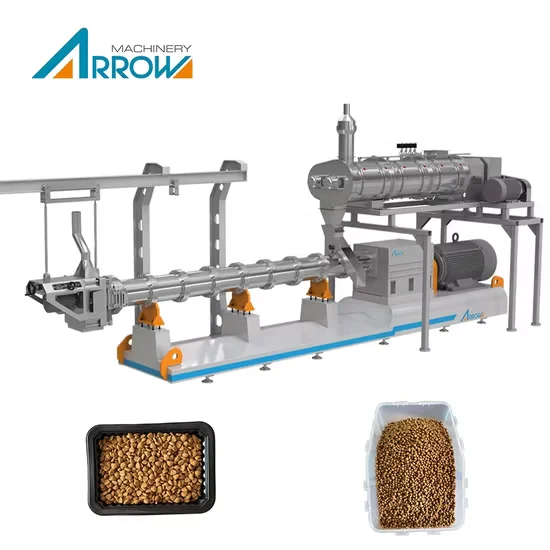
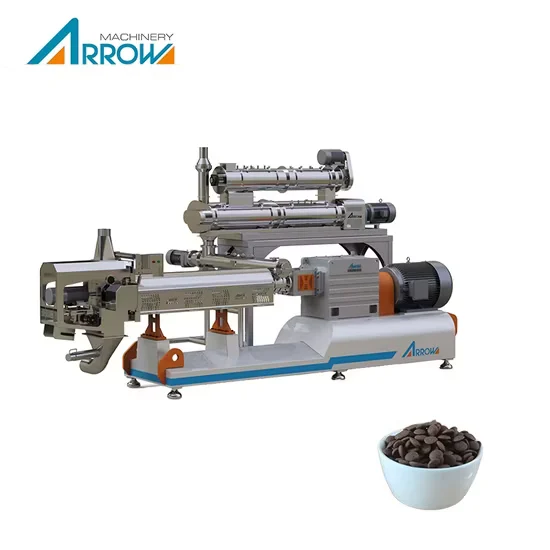
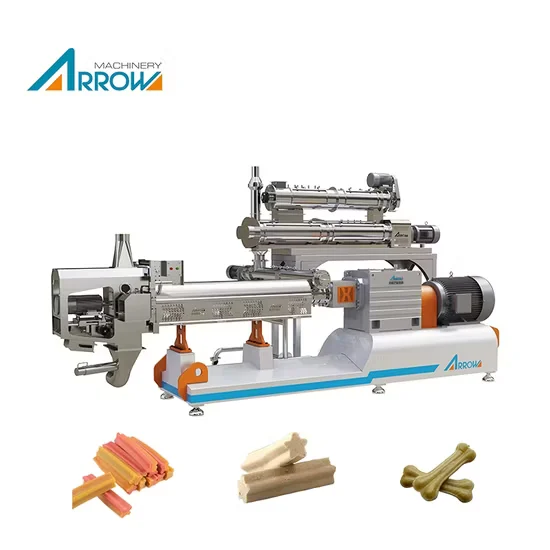
The extruder is the heart of the line, but the dryer is often the bottleneck. If the extruder produces kibble faster than the dryer can remove moisture, the product will spoil or fail quality tests. In a balanced system, the capacity of the Twin-Screw Extruder must align precisely with the drying and coating stages. For instance, a high-moisture formula requires longer retention times in the dryer, which reduces the effective throughput of the entire line.
For smaller setups, a Single-Shaft Paddle Mixer may suffice for blending ingredients before extrusion. However, as volume grows to 5 t/h, mixing uniformity becomes critical to ensure consistent pellet quality. A Twin-Shaft Paddle Mixer or Ribbon Mixer provides the homogeneity needed for large batches, preventing segregation of fine particles and fats. This consistency is vital before the material enters the extruder, where uneven feed can cause surging or blockages.
Drying technology also shifts with scale. Small lines might use simple cabinet dryers, but industrial volumes require efficient heat transfer. A Cross-Flow Circulation Dryer offers better energy efficiency and uniform drying for large volumes compared to static methods. The airflow design must match the bed depth of the kibble to ensure that interior moisture migrates to the surface without case-hardening the pellet.
Coating is another critical junction. At low volumes, a simple drum coater might work for surface seasoning. But for high-fat diets or premium products requiring precise nutrient addition, a Vacuum Coating Machine is essential. It forces flavor and oil into the porous structure of the kibble, preventing surface greasiness and ensuring shelf stability. Matching the coating cycle time to the extruder output prevents backlog and ensures every pellet receives an even layer.
Facility Layout and Utility Infrastructure
Layout design dictates operational efficiency. A 200 kg/h line can fit into a compact, modular footprint, allowing for flexible reconfiguration if product types change. This is ideal for contract processors handling diverse, small-batch orders. In contrast, a 5 t/h facility requires a linear, continuous-flow layout to minimize material handling and reduce the risk of contamination between stages.
Utility planning must be integral to the pet food line capacity planning process. Steam is often the primary heat source for preconditioning and drying. Calculating the peak steam demand requires understanding the worst-case scenario, such as starting up a cold line or processing a high-moisture recipe. Underestimating boiler capacity can stall production during critical startup phases.
Electrical loads also vary significantly. High-capacity extruders and large dryers draw substantial power. Voltage drops or insufficient transformer capacity can trip breakers and damage sensitive control electronics. Additionally, compressed air is needed for pneumatic conveying and actuator control. A dedicated air treatment system ensures clean, dry air, preventing moisture from entering the product stream or damaging pneumatic components.
Space for maintenance and access is often overlooked in tight layouts. Industrial equipment requires regular servicing, screw element changes, and die cleaning. Adequate clearance around the extruder and dryer allows technicians to work safely and efficiently. Ignoring these spatial requirements can lead to prolonged downtime during routine maintenance, eroding the productivity gains of a larger line.
Investment Visibility and Engineering Support
Navigating the transition from concept to commissioning requires clear visibility into costs and scope. A turnkey approach consolidates engineering, equipment supply, and installation into a single responsibility. This reduces the risk of interface issues between different suppliers, such as mismatched flanges or incompatible control protocols. Arrow supports this by providing integrated process coverage, ensuring that each module functions as part of a cohesive system.
Raw material trials are a crucial step before finalizing equipment specifications. Testing your specific formulation on a pilot scale helps identify potential issues with shear sensitivity or moisture absorption. This data informs the selection of screw configurations and dryer parameters, reducing the risk of poor performance after installation.
Commissioning and training are vital for long-term success. Overseas installation support ensures that the line is set up correctly according to the engineered design. Operator training empowers your team to manage daily operations, troubleshoot minor issues, and perform preventive maintenance. This knowledge transfer is essential for maintaining product quality and maximizing equipment lifespan.
Frequently Asked Questions
Q: Can I start with a 200 kg/h line and upgrade to 5 t/h later?
A: While modular designs allow for some expansion, jumping from 200 kg/h to 5 t/h usually requires a completely new line due to differences in utility demands and footprint. It is more cost-effective to plan for future capacity in the initial layout, leaving space for additional dryers or mixers, rather than trying to retrofit a small line for industrial volumes.
Q: What utilities are required for a 5 t/h dry pet food production line?
A: A 5 t/h line typically requires significant steam generation for conditioning and drying, stable three-phase power for heavy motors, and compressed air for pneumatic systems. Exact requirements depend on the recipe and equipment configuration. A detailed utility load list should be generated during the engineering phase to ensure your facility infrastructure can support the planned output.
Q: How does Arrow ensure the dryer and coating machine match the extruder capacity?
A: Equipment selection is based on your specific raw materials, target product characteristics, and desired throughput. We balance the duty points of each machine, ensuring the dryer can handle the moisture load from the extruder and the coater can process the volume without creating bottlenecks. This integrated approach prevents mismatches that compromise efficiency.
Q: Do you provide factory layout design for both small and large capacity projects?
A: Yes, we offer custom line layouts and equipment configuration for both new factories and retrofits. Our engineering team assesses your site dimensions, utility constraints, and process requirements to create a layout that optimizes flow and accessibility. This service helps visualize the integration of all systems before construction begins.
Send your raw material formulation, target capacity, and factory dimensions to receive a customized production line configuration and layout proposal. Discuss your specific process challenges with our engineering team to determine if pilot trials are needed before finalizing your equipment scope.