Many contract manufacturers planning a new steam-baked kibble line assume they can simply adjust parameters on their existing extruder. This oversight often leads to uneven moisture content, forcing the entire plant to slow down and risking product spoilage. The core issue is not just the forming method but the thermal balance across the whole system.
The fundamental difference between steam-baked and extruded kibble lies in the mechanical shear and thermal profile applied during forming. Extrusion relies on high pressure and friction to gelatinize starch, while steam-baking uses lower pressure and external heat to set the structure. Consequently, the equipment configuration for steam-baked vs extruded kibble equipment must differ significantly in the forming, drying, and coating stages to achieve stable texture and nutrition.
Forming Mechanics: High Shear Extrusion vs Low Pressure Baking
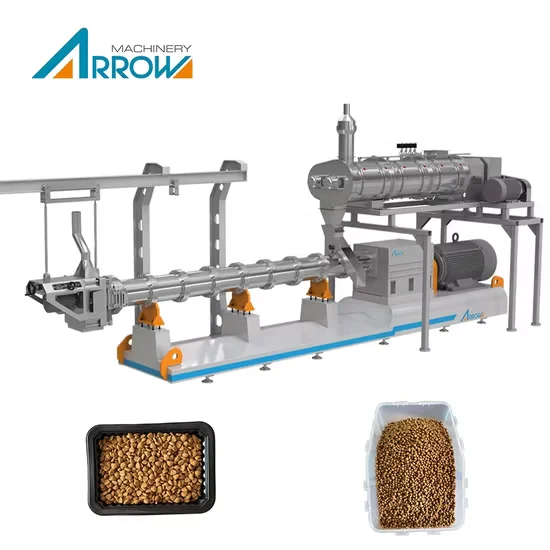
The formation of the kibble pellet defines its internal structure, which directly impacts digestibility and texture. In traditional dry pet food production, a Twin-Screw Extruder applies intense mechanical shear and heat through friction. This process fully gelatinizes starches, creating a porous, expanded structure that is ideal for high-volume dry kibble. The screw configuration, barrel temperature, and moisture input are critical variables that determine the degree of expansion and density.
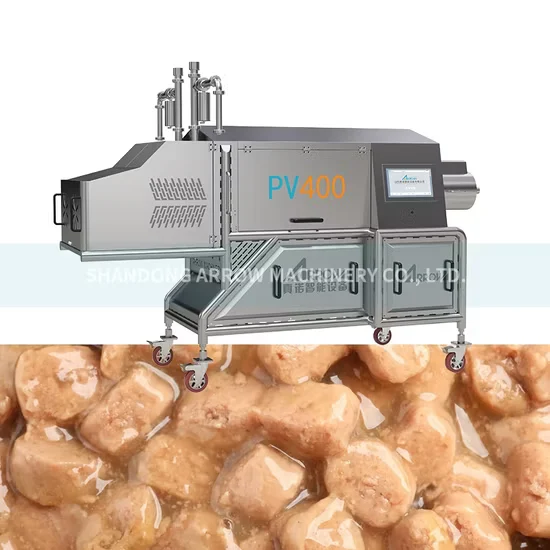
In contrast, steam-baked kibble requires a different approach to preserve heat-sensitive nutrients and achieve a denser, crunchier texture. A Baked Pet Food Forming Machine typically operates at lower pressures and temperatures compared to high-shear extruders. The dough is formed and then subjected to controlled steam and baking conditions rather than relying solely on frictional heat. This gentle forming process helps retain more natural flavors and vitamins from fresh meat inclusions, which might otherwise degrade under the extreme conditions of standard extrusion.
Choosing the right forming equipment depends on the desired product characteristics. If the goal is a highly expanded, lightweight kibble with maximum starch gelatinization, high-shear extrusion is the standard. However, for products emphasizing fresh meat content, dense texture, or specific nutritional retention, the lower shear environment of a baking former is preferable. It is essential to match the screw design or forming mechanism to the raw material viscosity and target bulk density.
Thermal Processing: Drying Systems for Moisture Control
Drying is often the bottleneck in any pet food production line, and the requirements differ markedly between extruded and steam-baked products. Extruded kibble, having undergone significant expansion, has a large surface area and open pore structure. This allows for relatively rapid moisture removal using standard Cross-Flow Circulation Dryers. The air circulation efficiently carries away surface moisture, and the internal water migrates quickly due to the porous matrix.
Steam-baked kibble, however, possesses a denser structure with fewer open pores. Moisture migration from the center to the surface is slower, requiring a more precise and often longer drying curve. If the drying rate is too aggressive, the exterior may harden while the interior remains moist, leading to stability issues and potential microbial growth. Therefore, the drying system for steam-baked lines must offer precise control over temperature zones and air velocity to ensure uniform moisture reduction without case hardening.
The choice of dryer also affects energy consumption and footprint. While extruded lines might prioritize high-throughput rotary or cross-flow dryers, steam-baked lines may benefit from multi-stage drying systems or specialized drying rooms that allow for extended residence times at lower temperatures. This careful thermal management preserves the integrity of the baked texture and prevents the cracking or crumbling often seen when dense pellets are dried too rapidly.
Post-Processing: Coating and Flavoring Integration
The final stage of production involves adding fats, flavors, and functional ingredients. The physical structure of the kibble determines how well it accepts these coatings. Extruded kibble, with its rough and porous surface, readily absorbs oils and palatability enhancers. Standard Single-Drum or Double-Drum Flavoring Machines are often sufficient to achieve even distribution, as the oil penetrates the surface irregularities easily.
Steam-baked kibble typically has a smoother, denser surface with less inherent porosity. This makes uniform coating more challenging, as oils tend to sit on the surface rather than being absorbed. To achieve consistent flavor and nutrient delivery, Vacuum Coating Machines are frequently recommended for steam-baked products. By reducing the pressure inside the coating drum, air is drawn out of the kibble pores, allowing the liquid coating to penetrate deeper into the pellet structure when pressure is restored.
This deeper penetration not only improves palatability but also reduces the risk of oil rancidity on the surface and minimizes dust in the final package. For high-fat formulations or premium treats where flavor consistency is critical, the investment in vacuum coating technology pays off in product quality. It ensures that every bite delivers the intended taste profile, which is particularly important for picky eaters or specialized dietary formulas.
Line Integration and Factory Footprint
Integrating these distinct processes into a single facility requires careful planning of utilities and layout. Extrusion lines generally demand high electrical power for the main drive motors and significant steam for preconditioning. Steam-baked lines, while potentially using less electrical power for forming, require substantial steam capacity for the baking ovens and precise humidity control in the drying section.
When evaluating steam-baked vs extruded kibble equipment, factory managers must consider the existing utility infrastructure. Retrofitting an existing plant for steam-baking may require upgrades to the boiler system and ventilation to handle the different heat and moisture loads. Additionally, the footprint of baking ovens and extended drying tunnels can be larger than compact extrusion and drying setups, influencing the overall plant layout.
Shandong Arrow Machinery supports both modular machinery purchases and integrated line projects, allowing customers to specify equipment around their specific process constraints. Whether upgrading an existing line or building a new facility, aligning the capacity of grinding, mixing, forming, drying, and coating units is crucial. Mismatched capacities lead to bottlenecks, such as a dryer that cannot keep up with the former, causing production delays and inconsistent product quality.
Frequently Asked Questions
Q: Can a standard twin-screw extruder produce both extruded and steam-baked kibble?
A: No, the mechanical principles are fundamentally different. Twin-screw extruders rely on high shear and pressure for expansion, while steam-baked kibble requires low-pressure forming followed by external baking. Using an extruder for baking would result in excessive expansion and nutrient degradation, failing to achieve the dense texture characteristic of baked products.
Q: How does the drying time differ between steam-baked and extruded kibble?
A: Steam-baked kibble generally requires a longer drying time due to its denser structure and lower porosity. Moisture migration from the center to the surface is slower compared to the highly porous extruded kibble. This necessitates precise control over drying temperature and duration to prevent case hardening while ensuring internal moisture reaches safe storage levels.
Q: What utility upgrades are needed to switch from extrusion to steam-baking?
A: Switching to steam-baking often requires increased steam capacity for the baking ovens and enhanced ventilation systems to manage humidity. Electrical loads may shift from high-power extruder drives to heating elements and fans. A thorough assessment of existing boilers, electrical supply, and airflow capacity is essential before modifying the production line.
Q: Does steam-baked kibble require a different coating machine than extruded kibble?
A: While drum flavorers can be used, vacuum coating machines are often preferred for steam-baked kibble. The denser, smoother surface of baked pellets absorbs oil less readily than porous extruded kibble. Vacuum coating forces the liquid into the pellet structure, ensuring better adherence, reduced surface oiliness, and improved flavor consistency.
Send your product formula and target capacity to receive a customized technical specification sheet and factory layout plan. Discuss whether your raw materials suit high-shear extrusion or low-pressure baking, and request a consultation on trial runs to validate the process before finalizing your equipment list.