Many brands pivoting to plant-based substrates discover that simply swapping bentonite granulation for starch extrusion leads to poor pellet formation and excessive dust. The transition is not a matter of changing raw materials but requires a complete reconfiguration of the mixing, forming, and drying stages.
Successful starch-based cat litter production depends on precise gelatinization control and a drying curve that matches the thermal mass of dense starch pellets. Unlike bentonite, which agglomerates with water, starch requires heat and shear to bind, making the extrusion and drying systems the critical determinants of final product hardness and low dust rates.
From Physical Agglomeration to Thermal Gelatinization
Bentonite clay relies on physical properties to form clumps. When water is added, the clay particles swell and stick together through capillary forces. This process occurs at ambient temperatures and requires minimal energy input beyond mixing and mechanical compaction. In contrast, starch-based cat litter production involves a chemical and physical transformation known as gelatinization. Starch granules must absorb water and be subjected to specific temperature and pressure conditions to rupture their crystalline structure, creating a viscous paste that can be shaped and dried into a solid matrix.
This fundamental difference means that equipment designed for cold compaction cannot handle starch formulations. The raw material mixture must be homogeneous before it enters the forming stage. Any inconsistency in moisture distribution or particle size at this stage will result in uneven cooking within the extruder barrel. If the starch is not fully gelatinized, the resulting pellets will lack structural integrity, leading to high breakage rates during handling and increased dust in the litter box.
The shift also changes how moisture is managed. In bentonite processing, water is a binding agent that is largely removed through evaporation or remains trapped in the clay structure. In starch extrusion, water acts as a plasticizer and a reactant. The amount of water added must be carefully balanced against the steam injection and mechanical energy input. Too little moisture prevents proper gelatinization, while too much creates a soggy mass that collapses after cutting. Understanding this balance is the first step in designing a viable starch-based cat litter production line.
Core Equipment Configuration for Starch-Based Lines
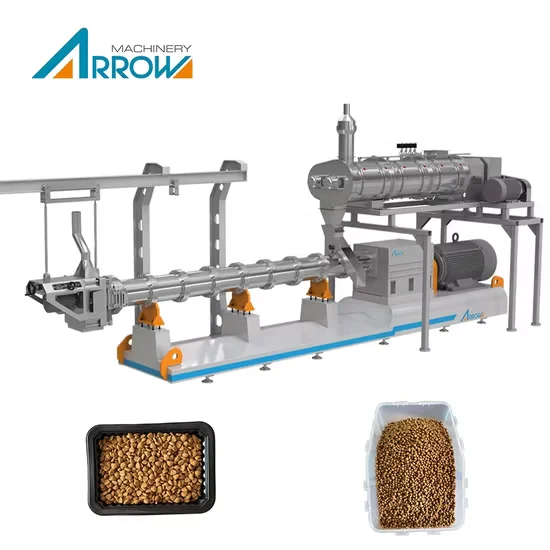
The heart of any starch-based system is the twin-screw extruder. Unlike single-screw machines, which rely primarily on frictional heat, twin-screw extruders offer precise control over shear rate, residence time, and temperature profiles. This control is essential for managing the complex rheology of starch blends, especially when incorporating other plant fibers or binding agents. The screws can be configured to provide high shear for thorough cooking or lower shear for products requiring less expansion. For starch-based cat litter, the goal is often minimal expansion to maintain density, which requires careful selection of screw elements and die geometry.
Following extrusion, the drying stage becomes the primary bottleneck if not properly sized. Starch pellets are dense and retain moisture internally even when the surface appears dry. A standard cross-flow circulation dryer may struggle to remove this internal moisture without causing case hardening, where the outer layer dries too quickly and cracks, trapping moisture inside. This leads to pellets that are brittle on the outside and soft on the inside, a common failure mode in poorly designed lines. The drying system must provide consistent airflow and temperature control to ensure uniform moisture removal throughout the pellet core.
Shandong Arrow Machinery offers integrated solutions where the Twin-Screw Extruder and Cross-Flow Circulation Dryer are matched to the specific thermal load of the formulation. This integration ensures that the output capacity of the extruder does not overwhelm the drying chamber. By coordinating these two critical units, manufacturers can achieve a stable production rhythm that maintains product quality across long runs. The equipment selection is based on the specific ingredient ratios and target moisture content, ensuring that the thermal balance is maintained from the feeder to the cooler.
Solving Dust and Durability Challenges in Plant-Based Formulations
Dust generation in plant-based litters is often a symptom of poor pellet durability. When pellets break during packaging, transport, or use, they create fine particles that reduce the perceived quality of the product. To mitigate this, the mixing stage must ensure that all dry ingredients are uniformly distributed before water and steam are added. Using a Single-Shaft or Twin-Shaft Paddle Mixer can improve the homogeneity of the pre-conditioned mash, leading to more consistent extrusion behavior. Inconsistent mixing results in weak spots in the pellet structure that fracture under stress.
The extrusion parameters also play a crucial role in determining hardness. Higher shear and temperature generally increase gelatinization, which improves binding but can also lead to excessive expansion if not controlled. For cat litter, the focus is on creating a dense, hard pellet that resists abrasion. This may require adjusting the screw configuration to reduce expansion and increase compression. Additionally, the die design must produce smooth, uniform strands that cut cleanly. Rough edges or irregular shapes are more prone to breaking and generating dust.
Post-extrusion handling is another area where dust can be introduced. Pneumatic conveying systems must be designed to minimize impact velocity, and screening equipment should be used to remove fines before packaging. Vacuum coating machines, typically used for adding flavors to pet food, can also be adapted to apply dust-suppressing agents or odor-control additives to the surface of the litter pellets. This surface treatment can further enhance the user experience by reducing airborne particles and improving clumping performance.
Factory Layout and Utility Considerations for Line Upgrades
Switching from bentonite to starch-based production often requires significant changes to the factory layout. Bentonite lines are relatively compact and require minimal utility infrastructure beyond power and water. Starch extrusion lines, however, need space for preconditioning, extrusion, drying, and cooling. The drying section, in particular, can be lengthy due to the extended residence time required for thorough moisture removal. Manufacturers must assess their available floor space and ceiling height to accommodate these larger footprints.
Utility requirements also increase substantially. Steam is a critical component for achieving the necessary temperatures for gelatinization. Facilities that previously relied only on electrical heating for bentonite drying may need to install boilers or upgrade their steam supply capacity. Electrical loads will also rise due to the higher power demands of twin-screw extruders and large circulation fans in the drying system. Water usage may change as well, depending on the specific formulation and whether steam condensation is recovered.
A thorough evaluation of the existing infrastructure is essential before purchasing new equipment. This includes checking the capacity of the electrical transformer, the availability of steam or thermal oil, and the ventilation system’s ability to handle increased humidity and heat. Shandong Arrow Machinery supports customers in evaluating these utility constraints during the planning phase. By integrating process consultation with equipment configuration, the company helps buyers avoid costly retrofits and ensures that the new line operates efficiently within the existing facility limits.
Frequently Asked Questions
Q: Can existing bentonite pelletizers be reused for starch-based cat litter?
A: No, bentonite pelletizers rely on mechanical compaction of clay, while starch requires thermal gelatinization via extrusion. The processes are fundamentally different in terms of energy input and material behavior. Attempting to use cold compaction equipment for starch formulations will result in poor binding, low durability, and high dust levels. A dedicated extrusion system is necessary to achieve the required structural integrity.
Q: What is the key to reducing dust in plant-based cat litter production?
A: Reducing dust starts with achieving high pellet durability through complete starch gelatinization and uniform drying. Incomplete cooking or uneven moisture removal leads to brittle pellets that break easily. Optimizing the mixing process, selecting the right screw configuration for density, and using a properly sized drying system are critical steps. Post-production screening and surface coating can further minimize fines and improve the final product quality.
Q: How does the drying process differ for starch cat litter compared to bentonite?
A: Bentonite drying primarily removes surface moisture from physically bound water, whereas starch drying must remove moisture trapped within the gelatinized matrix. Starch pellets are denser and require longer residence times and controlled temperature gradients to prevent case hardening. A cross-flow circulation dryer with precise airflow control is typically needed to ensure the core moisture is reduced without damaging the pellet structure, unlike the simpler drying needs of clay.
Q: What utility upgrades are needed when switching to a starch extrusion line?
A: Switching to starch extrusion usually requires significant upgrades to steam and electrical systems. Steam is essential for preconditioning and gelatinization, so boiler capacity may need to be increased. Electrical loads will rise due to the power demands of twin-screw extruders and large drying fans. Facilities should also evaluate their ventilation systems to handle increased heat and humidity. A detailed utility assessment is recommended before finalizing the equipment layout.
Send your starch-based formula and target capacity to receive a custom production line technical proposal and workshop layout diagram. Discuss your raw material trial requirements and request technical specifications to ensure your facility is ready for the transition.