
Extrusion Process Notes Buying Guide
Kibble Line Buying Guide for Large-Breed Dog Food Shapes
This guide addresses surface cracking and uneven drying in large-breed kibble production caused by uncalibrated extrusion shear and airflow. Learn to balance screw configurations with cross-flow circulation drying for consistent quality and effective moisture removal in thick pieces.

Many factories switching to large-breed kibble shapes discover surface cracking or uneven drying, not because of the formula, but because extrusion shear and dryer airflow were never recalibrated for the increased thickness. The core stays soft while the exterior looks crisp, creating a moisture gradient that invites spoilage. Producing these larger shapes requires more than just swapping a die plate; it demands a synchronized approach between the twin-screw extruder, specialized forming systems, and a drying profile that respects the physical dimensions of the product.
To achieve consistent quality in large-breed dog food production, you must balance cutting precision with a drying strategy that penetrates thick pieces effectively. This means selecting screw configurations that provide adequate mixing without excessive shear heat, using forming equipment that maintains shape integrity, and employing a cross-flow circulation dryer that ensures uniform air distribution. Without this holistic view, your final product will fail before it ever reaches the bag.
Understanding the Extrusion Challenges of Large-Breed Kibble Shapes
Producing large kibble shapes introduces specific thermal and mechanical stresses that differ significantly from standard small-pellet production. As the size of the kibble increases, the surface-area-to-volume ratio decreases* during extrusion and for moisture to escape during drying. If the shear force inside the barrel is too high, the dough can overheat, leading to structural weakness and surface cracking once the product exits the die. Conversely, insufficient shear may result in poor starch gelatinization, causing the kibble to lack the necessary durability for handling and packaging.
The design of the die and the cutting system plays a critical role in maintaining the fidelity of complex large shapes, such as big bones or stars. Standard cutting speeds may not align with the extrusion rate required for larger volumes, leading to deformation or tailing on the kibble edges. For large-breed dog food kibble line setups, it is essential to evaluate how the cutter head interacts with the emerging dough strand. A mismatch here can cause irregular shapes that not only look unappealing but also dry inconsistently, as irregular surfaces create varying exposure to airflow.
Furthermore, the transition from laboratory trials to full-scale production often reveals discrepancies in how large shapes behave under continuous operation. In a lab setting, a single batch might dry uniformly, but in a continuous line, the center of a large pile of kibble retains heat and moisture differently than the outer layers. This is why understanding the rheology of your specific raw material mix is vital. Ingredients with high fresh meat content or unique fiber profiles react differently to pressure and temperature, requiring careful adjustment of the extrusion parameters to avoid blockages or quality drops.
Selecting the Right Twin-Screw Extruder for Large Pellets
When configuring a line for large kibble, the twin-screw extruder serves as the heart of the process, but its setup must be optimized for low shear and high filling characteristics. Large pellets require a stable, well-cooked dough that can hold its shape without becoming too brittle or too soft. The screw configuration should be chosen to provide thorough mixing and cooking while minimizing frictional heat generation. This often involves using conveying elements that move material efficiently through the barrel without excessive compression, ensuring that the temperature profile remains controlled throughout the extrusion zone.
The thickness of the die plate and the diameter of the apertures are decisive factors for the density and expansion rate of large dog food kibble. A thicker die plate can increase backpressure, which may improve cooking but also raise the risk of overheating if not managed correctly. For large-breed applications, engineers often recommend adjusting the length-to-diameter ratio of the screws to allow for longer residence times at lower temperatures. This approach helps achieve the desired degree of starch conversion without compromising the structural integrity of the large shapes.
Shandong Arrow Machinery supports this selection process by evaluating your specific ingredient ratios and target product characteristics. Rather than offering a one-size-fits-all machine, the engineering team assesses whether your formulation requires specific screw elements or barrel configurations to handle the viscosity of large-shape doughs. This application-based selection ensures that the extruder operates within its optimal duty point, reducing wear and maintaining consistent output quality over long production runs.
Matching the Drying System to Large Kibble Dimensions
Drying is frequently the bottleneck in any pet food production line, and this challenge is magnified when producing large kibble. Traditional drying methods often struggle to remove moisture from the core of thick pieces without over-drying the surface. This results in the “case hardening” effect, where a hard shell forms around a moist interior, creating a breeding ground for mold and bacteria during storage. To prevent this, the drying system must provide gentle, uniform heat and airflow that can penetrate deep into the kibble mass.
The Cross-Flow Circulation Dryer is particularly effective for large kibble because it distributes air evenly across the product bed, reducing hot spots and ensuring consistent moisture removal. Unlike simple convection dryers that may blow air from one direction, cross-flow systems circulate air through the product layer, allowing for better heat transfer efficiency. This uniformity is crucial for large-breed dog food kibble line operations, where even a small variation in moisture content can lead to significant quality issues in the final packaged product.
Balancing the capacity of the dryer with the extruder output is essential to avoid bottlenecks. If the extruder produces large kibble faster than the dryer can handle, the product may sit in holding bins, leading to condensation and clumping. Therefore, the dryer’s residence time and temperature settings must be calibrated to match the specific thickness and density of the large shapes being produced. This integration ensures that the line runs smoothly without frequent stops for quality checks or equipment adjustments.
Integrating Forming and Coating for Premium Large-Breed Diets
For manufacturers looking to produce premium large-breed diets, the forming and coating stages add significant value. The Baked Pet Food Forming Machine offers an alternative to traditional extrusion for certain large, complex shapes that require a denser texture or specific surface characteristics. This equipment allows for greater flexibility in shape design, enabling the production of unique kibble forms that appeal to owners of giant breeds. When combined with extrusion, it provides a versatile toolkit for meeting diverse market demands.
Once the kibble is dried, coating becomes critical for palatability and nutritional completeness. Large kibble pieces have less surface area relative to their volume, making it challenging to apply sufficient fat and flavor using standard drum coaters. The Vacuum Coating Machine addresses this by forcing oils and flavors into the porous structure of the kibble under vacuum conditions. This method ensures that the coating is distributed evenly, both on the surface and within the internal pores, enhancing taste and preventing the greasy residue often associated with surface-only application.
Integrating these systems requires a clear understanding of the entire process flow. From ingredient preparation to final packaging, each stage must be aligned to support the production of large, high-quality kibble. By consolidating the engineering scope into one proposal, manufacturers can ensure that all components work together harmoniously, reducing the risk of compatibility issues and simplifying future maintenance and upgrades.
Frequently Asked Questions
Q: Can a standard twin-screw extruder handle large-breed kibble shapes without modifying the screw configuration?
A: While a standard twin-screw extruder can physically produce large shapes, optimal performance usually requires adjusting the screw configuration. Large kibble demands specific shear and mixing profiles to ensure proper cooking without overheating. Modifying the screw elements helps manage the dough’s viscosity and temperature, preventing structural defects and ensuring consistent quality throughout the production run.
Q: Why do my large dog food pellets crack after drying, and how can the dryer settings prevent this?
A: Cracking often results from rapid moisture loss at the surface while the core remains wet, creating internal stress. To prevent this, use a drying system like the Cross-Flow Circulation Dryer that provides gentle, uniform airflow. Adjusting the temperature gradient and extending the drying time allows moisture to migrate from the core to the surface gradually, reducing stress and maintaining the structural integrity of the large kibble.
Q: How does the vacuum coating machine ensure even fat distribution on large, complex-shaped kibbles?
A: The Vacuum Coating Machine uses negative pressure to draw oils and flavors into the porous structure of the kibble. This method ensures that the coating penetrates beyond the surface, providing uniform distribution even on complex shapes with limited external surface area. This results in better palatability and prevents the greasy residue often seen with traditional drum coating methods.
Q: What is the typical capacity difference when switching a kibble line from small to large-breed shapes?
A: Switching to large-breed shapes typically reduces the hourly throughput in terms of particle count, though weight capacity may remain similar depending on density. Larger shapes require longer drying times and may slow down the cutting process. It is essential to rebalance the line, particularly the dryer and cooler sections, to accommodate the changed residence time requirements and maintain overall efficiency.
Send your target shape specifications, raw material formulation, and expected capacity to receive a customized technical specification sheet and factory layout plan. Our engineering team can also discuss raw material trials to validate the process before you commit to equipment configuration.
Equipment in This Process
Machines mentioned in this article
Each machine is built at the Shandong Arrow Machinery factory and supplied as a standalone unit or as part of a complete extrusion line.
01 Dry Pet Food Production Line
Twin Screw Extruder for Dry Kibble Dog Food Production Line
View machine details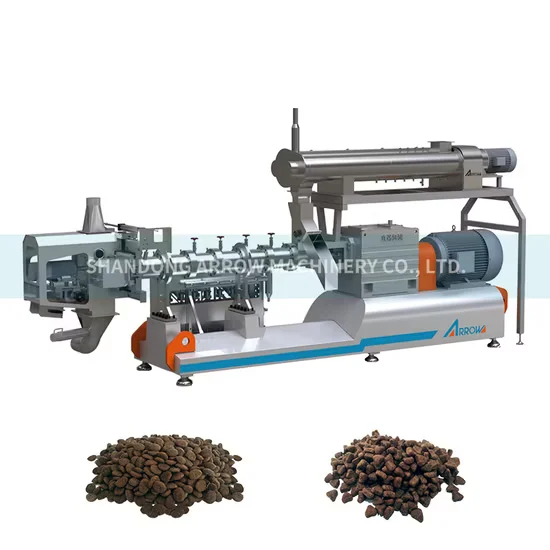 02
Dry Pet Food Production Line
Pet Food Production Line for Dog and Cat Kibble Manufacturing
View machine details 03
Dry Pet Food Production Line
Dog Kibble Production Line for Pet Food Process Equipment
View machine details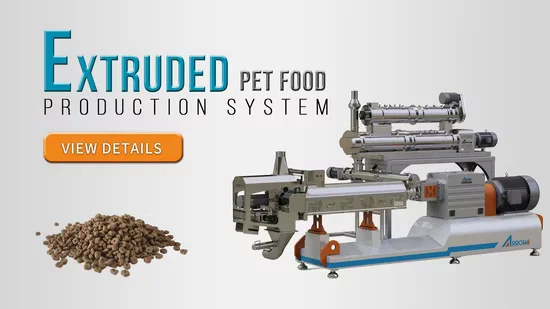 04
Dry Pet Food Production Line
Dry Kibble Pet Food Production Line for Dog and Cat
View machine detailsFurther Reading
Related extrusion process notes



Configured Quotation
Send your formula and capacity for a configured line proposal
Shandong Arrow Machinery engineers review your raw materials, product shape and kg/h or t/h target, then propose a single machine or complete pet food, aquafeed or specialty feed line.
- Emailinfo@arrowextrusion.com
- WhatsApp+86 137 9316 7756
- FactoryNo. 47 Chengbohu Road, Jibei Subdistrict, Jiyang District, Jinan, Shandong, China
Request a Quote
Payment by T/T, L/C or Alibaba Trade Assurance. Scope, delivery time and commissioning support are stated in the formal quotation.