
Extrusion Process Notes Buying Guide
Kibble Line for Senior and Weight-Control Dogs: 5 Key Factors
Producing low-fat, large-kibble diets for senior dogs often causes poor formation and uneven drying in standard lines. Learn how precise twin-screw extrusion control and gentle cross-flow drying ensure structural integrity and consistent quality.

Low-fat formulas and large, easy-to-chew kibble designs often push traditional dry pet food lines to their limits, resulting in poor formation rates and uneven drying. Selecting the right combination of extrusion and drying processes is far more critical than simply chasing maximum throughput when producing specialized diets.
The core solution lies not in a single machine but in precise control. By adjusting shear and temperature profiles in the twin-screw extruder, matching forming dies for large particles, and employing a gentle, uniform drying system, manufacturers can ensure high formation rates and preserve the structural integrity required for senior and weight-control dog food.
Formulation Challenges in Low-Fat and Senior Dog Kibble
Developing kibble for senior dogs or weight management programs introduces specific rheological challenges that standard high-starch, high-fat recipes do not face. Low-fat formulations typically contain higher levels of fiber or protein to maintain satiety and nutritional balance, which significantly alters the viscosity of the melt inside the barrel. Without adequate moisture and thermal energy, these mixes may fail to expand properly, leading to dense, hard pellets that are difficult for older dogs to chew.
Furthermore, the physical design of the kibble itself poses a processing hurdle. Senior dog food often requires larger diameters or unique shapes to encourage slower eating and easier mastication. Large cross-sections mean heat and moisture must travel further from the center to the surface during drying. If the process is not carefully balanced, the exterior may over-dry and crack while the interior remains too moist, creating a risk of microbial growth and reducing shelf stability.
Twin-Screw Extrusion Control for Gentle Processing
A twin-screw extruder offers the flexibility needed to handle these tricky ingredient profiles. Unlike single-screw systems, which rely heavily on friction and have limited mixing capability, twin-screw configurations allow for precise modulation of shear stress and residence time. For low-fat recipes, it is essential to minimize excessive shear that can degrade sensitive nutrients or cause overheating, while still providing enough mechanical energy to gelatinize starches and denature proteins.
The ability to segment the screw profile is key. Engineers can arrange conveying, kneading, and reverse elements to create specific pressure zones. This ensures that the material reaches the necessary temperature for cooking without relying solely on external heating, which can be uneven. By fine-tuning the screw speed and feed rate, operators can achieve a consistent melt quality even when raw material batches vary slightly in moisture or composition. This level of control is vital for maintaining the structural integrity of the kibble before it even reaches the die.
Precision Forming and Cutting for Large Kibbles
Once the conditioned meal exits the extruder, the forming and cutting stage defines the final product shape. For senior dog food, consistency in diameter and length is non-negotiable. Irregular shapes lead to uneven drying and poor packaging efficiency. The die plate must be designed with sufficient land length to provide backpressure, ensuring uniform expansion across all holes. If the pressure drops too quickly, the kibble may collapse or develop surface cracks as it cools.
Cutting mechanisms also play a crucial role. For large kibbles, a variable-speed cutter allows operators to adjust pellet length independently of the extrusion rate. This decoupling ensures that the density and texture remain consistent even if the target length changes. Additionally, the knife material and angle must be optimized to prevent sticking or deformation, especially when dealing with sticky, low-fat doughs that may lack the lubricity provided by higher fat contents.
Uniform and Gentle Drying to Preserve Structure
Drying is frequently the bottleneck in any kibble line for senior dogs, particularly when dealing with large, dense pellets. Rapid surface drying can create a hard shell that traps internal moisture, leading to case hardening. To avoid this, a Cross-Flow Circulation Dryer is often the preferred choice. This system uses a controlled airflow that passes through the product bed uniformly, removing moisture at a rate that allows internal water to migrate to the surface without causing structural stress.
The gentle nature of cross-flow drying helps preserve the porous structure created during extrusion. This porosity is important for the subsequent coating stage, as it allows flavorants to penetrate slightly rather than just sitting on the surface. By maintaining lower temperatures and optimizing air velocity, manufacturers can reduce energy consumption while achieving the target moisture content safely. This step is critical for ensuring that the final product meets the strict moisture specifications required for long-term storage and nutritional accuracy.
Coating for Palatability and Line Integration
After drying, the kibble must be coated to enhance palatability, a challenge when fat levels are restricted. Traditional drum coating can be abrasive, potentially breaking large, brittle kibbles designed for senior dogs. A Vacuum Coating Machine offers a superior alternative by pulling flavorants and oils into the pores of the kibble under negative pressure. This method ensures even distribution with minimal mechanical stress, preserving the physical integrity of the pellet.
Integrating these stages into a cohesive line requires careful attention to capacity matching. The throughput of the extruder must align with the drying and cooling capacities to prevent bottlenecks. When planning a new facility or upgrading an existing one, it is advisable to conduct raw material trials to validate the entire process flow. This approach ensures that each component, from the mixer to the packaging unit, operates in harmony, reducing waste and improving overall equipment effectiveness.
Frequently Asked Questions
Q: Can a standard twin-screw extruder handle low-fat recipes for weight-control dog food?
A: Yes, but it requires specific screw configuration adjustments. Standard setups designed for high-starch, high-fat diets may generate excessive shear or insufficient cooking for low-fat, high-fiber mixes. By modifying the screw elements to optimize mixing and residence time, the extruder can effectively gelatinize starches and form stable kibble without compromising nutritional value or structural integrity.
Q: How do you ensure large kibbles for senior dogs dry evenly without cracking?
A: Even drying relies on controlling the rate of moisture removal. Using a Cross-Flow Circulation Dryer allows for gentle, uniform airflow that prevents case hardening. It is crucial to match the drying temperature and duration to the kibble’s thickness. Rapid drying causes surface cracks, so a slower, controlled process ensures internal moisture migrates outward steadily, maintaining the pellet’s shape and preventing breakage during handling.
Q: What is the difference between cross-flow dryers and external air circulation dryers for large kibble?
A: Cross-flow dryers pass air directly through the product bed, offering superior uniformity and efficiency for large, dense kibbles. External air circulation dryers typically blow air over the surface, which can lead to uneven drying and longer cycle times for thick pellets. For senior dog food where structural integrity is paramount, cross-flow systems provide the gentle, consistent drying needed to prevent internal moisture traps and surface defects.
Q: Can we upgrade our existing kibble line to produce senior dog food with minimal layout changes?
A: Often, yes. Upgrading may involve replacing the die plate and cutter for larger shapes, adjusting screw configurations in the extruder, and optimizing dryer settings. If the current dryer lacks capacity for slower, gentler drying, adding a vacuum coater can improve palatability without extensive structural changes. A technical review of your current layout and utility constraints can identify specific modules that need replacement or adjustment to meet new product requirements.
Send your senior dog or weight-control formula along with your target capacity to receive a customized twin-screw extruder selection plan and workshop layout. We can discuss raw material trials to validate the process before finalizing equipment specifications.
Target Industries Covered in This Article
Equipment in This Process
Machines mentioned in this article
Each machine is built at the Shandong Arrow Machinery factory and supplied as a standalone unit or as part of a complete extrusion line.
01 Dry Pet Food Production Line
Twin Screw Extruder for Dry Kibble Dog Food Production Line
View machine details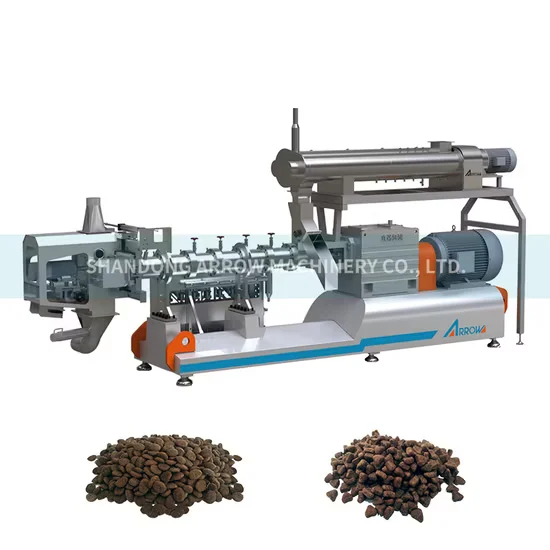 02
Dry Pet Food Production Line
Pet Food Production Line for Dog and Cat Kibble Manufacturing
View machine details 03
Dry Pet Food Production Line
Dog Kibble Production Line for Pet Food Process Equipment
View machine details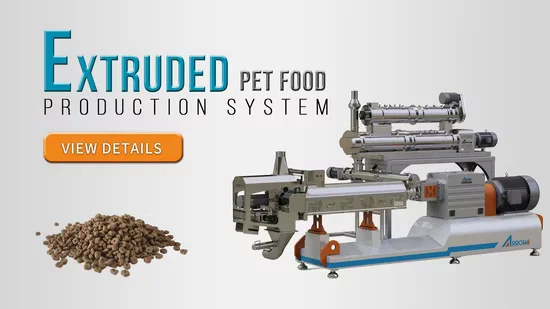 04
Dry Pet Food Production Line
Dry Kibble Pet Food Production Line for Dog and Cat
View machine detailsFurther Reading
Related extrusion process notes



Configured Quotation
Send your formula and capacity for a configured line proposal
Shandong Arrow Machinery engineers review your raw materials, product shape and kg/h or t/h target, then propose a single machine or complete pet food, aquafeed or specialty feed line.
- Emailinfo@arrowextrusion.com
- WhatsApp+86 137 9316 7756
- FactoryNo. 47 Chengbohu Road, Jibei Subdistrict, Jiyang District, Jinan, Shandong, China
Request a Quote
Payment by T/T, L/C or Alibaba Trade Assurance. Scope, delivery time and commissioning support are stated in the formal quotation.