
Extrusion Process Notes Buying Guide
Solving the Wet vs Dry Pet Food Line Choice for New Brands
This guide clarifies the critical engineering differences between dry and wet pet food production lines for new brands. You will learn to evaluate capital investment, raw material handling, and scalability to choose the right manufacturing path.

Many new pet food brands assume that the higher retail price of wet food translates to an easier entry into manufacturing. They overlook how moisture content dictates the entire engineering scope, from raw material handling to final packaging. I once watched a client attempt to run a high-meat wet recipe through a standard dry kibble setup. The extruder choked on the fresh meat, and the dryer could not remove moisture fast enough, leading to uneven product quality and mold risks. This experience highlights why understanding the mechanical differences between these two paths is critical before signing any equipment contract.
The core decision for a new brand is not just about market trends but about process feasibility. Dry kibble lines offer scalable capacity and longer shelf life with established drying technologies, while wet food lines provide premium differentiation but require strict sterilization and packaging coordination. Your choice should depend on your raw material supply, target product characteristics, and initial budget for utilities and factory footprint.
Capital Investment and Factory Footprint: Dry vs. Wet
When planning a new facility, the physical space and utility requirements differ significantly between dry and wet production. A Dry Pet Food Production Line typically centers on thermal processing and moisture removal. The equipment footprint includes grinders, mixers, extruders, and large drying systems. While the machinery list is long, the process is continuous and well-understood. The primary capital cost drivers are the extrusion system and the drying capacity, as removing water efficiently is energy-intensive.
In contrast, a Wet Pet Food Production Line involves different downstream challenges. After forming meat chunks or texturized products, the focus shifts to filling, sealing, and sterilization. This requires significant floor space for packaging machines and retorts or autoclaves. Utilities such as steam and water consumption are higher per ton of output compared to dry kibble. New investors must account for these operational costs and the complexity of managing a sterile environment, which adds to the initial investment in facility design and hygiene protocols.
For brands considering a phased approach, starting with a standalone Twin-Screw Extruder allows for flexibility. You can produce semi-moist treats or dry kibble components before committing to a full wet food canning or pouching line. This modular strategy reduces upfront risk and lets you validate your recipe in the market before scaling up to a complete turnkey plant.
Raw Material Handling and Processing Flexibility
The formulation of your product directly influences the type of extrusion technology required. Dry kibble often uses a blend of meat meal, grains, and fats. When fresh meat inclusion is low, standard preconditioning and extrusion work well. However, if your recipe calls for high levels of fresh meat or specific functional ingredients, the shear and temperature profile of the extruder must be precise. Twin-screw extruders offer better control over mixing and cooking compared to single-screw units, making them suitable for complex formulations.
Wet food processing, such as producing meat chunks or texturized wet food, relies heavily on the ability to maintain structure under high moisture conditions. The Wet Food Meat Chunks Processing Line uses specialized forming techniques that differ from standard kibble cutting. Here, the goal is not expansion but texture preservation. The raw material preparation stage must ensure uniform particle size and consistent mixing to prevent blockages in the forming dies.
Cold extrusion is another option for certain treats or specialty feeds where minimal heat exposure is desired. Unlike traditional hot extrusion, cold extrusion focuses on shaping without significant starch gelatinization. This method is ideal for products that require a dense texture or specific nutritional retention. Understanding whether your recipe needs puffing (dry kibble) or structuring (wet chunks) will determine whether you need a high-temperature short-time extruder or a low-temperature forming system.
Drying, Coating, and Downstream Integration
In dry kibble manufacturing, the dryer is often the bottleneck of the entire line. After extrusion, the product contains high moisture that must be reduced to ensure shelf stability. A Cross-Flow Circulation Dryer is commonly used because it provides uniform air distribution and efficient moisture removal. If the dryer is undersized, the product may remain too moist, leading to spoilage, or too dry, causing brittleness. Matching the dryer capacity to the extruder output is essential for consistent quality.
Once dried, the kibble needs flavor and fat coating. Vacuum coating machines are effective for adding high levels of fat or liquid palatability enhancers without making the surface greasy. For surface-level seasoning, drum flavoring machines provide a simpler solution. The choice depends on your target fat content and the type of coating ingredient. Integrating these systems requires careful planning of conveyor transfers and dust control to maintain a clean factory environment.
For wet food lines, the downstream process is entirely different. Instead of drying, the product goes through sterilization. This step is critical for food safety and shelf life. The coordination between the forming machine, filler, and sterilizer must be precise to avoid bottlenecks. Any delay in packaging can lead to product degradation. Therefore, when designing a wet food plant, the focus shifts from thermal drying efficiency to hygienic design and automated packaging speed.
Market Positioning and Production Scalability
Choosing between dry and wet lines also depends on your business model. Dry kibble benefits from economies of scale. It is easier to store, transport, and distribute due to its low weight and long shelf life. This makes it suitable for mass-market brands and private-label contract processors who need high throughput. The Dry Pet Food Production Line can be scaled up by adding parallel extruders or larger dryers, allowing for gradual capacity expansion.
Wet food commands a higher price point but faces stricter logistics requirements. The heavy weight of canned or pouched food increases shipping costs, and the shorter shelf life after opening limits consumer usage patterns. However, wet food offers differentiation through texture and fresh ingredient claims. Brands targeting premium segments or specific health needs may find wet food more appealing despite the higher production complexity.
Scalability also involves the ability to switch between products. A flexible extrusion system can produce various kibble shapes and sizes by changing dies and adjusting screw configurations. This versatility is valuable for contract manufacturers serving multiple clients. In contrast, wet food lines are often dedicated to specific package types and textures, making product changes more time-consuming. Evaluating your long-term product roadmap will help determine which line offers the best strategic fit.
Frequently Asked Questions
Q: Can I start with a single extruder and expand to a complete line later?
A: Yes, many customers begin with a standalone twin-screw extruder to test recipes and produce small batches. This allows you to validate market demand before investing in upstream grinding and downstream drying systems. We can configure the initial machine to integrate with future modules, ensuring compatibility as your capacity grows.
Q: What are the main utility requirements for a wet pet food processing plant?
A: Wet food plants require significant steam for sterilization and water for cleaning and processing. You will also need reliable electricity for packaging machines and compressors for pneumatic systems. It is crucial to assess your local utility availability and costs early in the planning phase to avoid operational bottlenecks.
Q: How do I choose between a twin-screw extruder and a cold extruder for my recipe?
A: Twin-screw extruders are ideal for cooked, expanded products like dry kibble where starch gelatinization is needed. Cold extruders are suitable for products that require shaping without heat, such as certain treats or dense chews. The choice depends on your desired texture, ingredient sensitivity, and nutritional goals.
Q: Do you support recipe trials before I commit to a full production line?
A: Yes, we offer raw material trials and testing support to evaluate how your specific formula behaves in our equipment. This helps us recommend the right screw configuration and process parameters. Trial availability and costs are confirmed during the technical review phase to ensure the proposed solution matches your production needs.
Send your product formula, target capacity, and desired shape to receive a customized technical proposal. We can provide detailed equipment configurations, factory layout options, and information on raw material trials to help you make an informed decision.
Target Industries Covered in This Article
Equipment in This Process
Machines mentioned in this article
Each machine is built at the Shandong Arrow Machinery factory and supplied as a standalone unit or as part of a complete extrusion line.
01 Kibble Pet Food Production Line
Automatic Fresh Meat Dry Pet Food Line for Dog Cat
View machine details 02
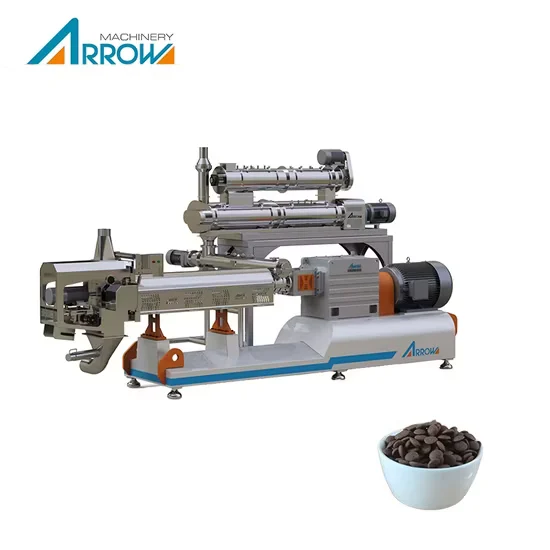
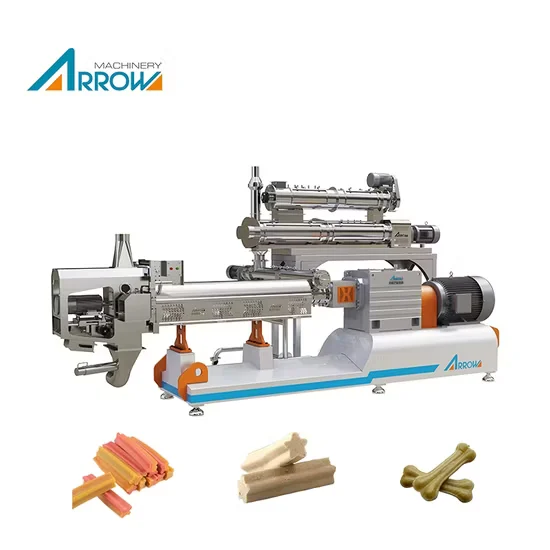
Dry Pet Food Production Line
Dry Dog Food Extruder for Pet Food Production Line
View machine details 03
Dry Pet Food Production Line
Dry Pet Food Manufacturing Line Extruded Plant Equipment
View machine details 04
Dry Pet Food Production Line
Dry Dog Food Extruder Equipment for Pet Food Production Line
View machine detailsFurther Reading
Related extrusion process notes


Configured Quotation
Send your formula and capacity for a configured line proposal
Shandong Arrow Machinery engineers review your raw materials, product shape and kg/h or t/h target, then propose a single machine or complete pet food, aquafeed or specialty feed line.
- Emailinfo@arrowextrusion.com
- WhatsApp+86 137 9316 7756
- FactoryNo. 47 Chengbohu Road, Jibei Subdistrict, Jiyang District, Jinan, Shandong, China
Request a Quote
Payment by T/T, L/C or Alibaba Trade Assurance. Scope, delivery time and commissioning support are stated in the formal quotation.