
Extrusion Process Notes Buying Guide
Steam-Baked Kibble Lines: Solving Texture and Moisture Issues
This article addresses uneven moisture distribution and fragile textures in traditional extrusion by explaining how a steam-baked kibble line solves these quality issues. Readers learn to evaluate critical equipment configurations like cross-flow dryers for achieving consistent product density and stability.

Traditional high-temperature extrusion often sacrifices nutritional integrity and textural nuance for the sake of throughput, leaving brands struggling to differentiate in a saturated market. While steam-baking offers a pathway to superior kibble quality, many factories face immediate hurdles with uneven moisture distribution and fragile textures during the transition. The core solution lies not merely in switching heating methods, but in ensuring precise synchronization between the forming, drying, and coating stages of your production line.
Why Traditional Extrusion Struggles with Texture and Moisture Consistency
Standard dry pet food production relies on high shear and temperature to gelatinize starches and expand the product. This process is efficient for creating lightweight, porous kibble, but it often results in a brittle structure that lacks the dense, meat-like bite increasingly demanded by premium segment consumers. The rapid expansion creates internal voids that can lead to inconsistent density, making the final product prone to breaking during packaging and transport.
More critically, traditional extrusion frequently struggles with moisture control when formulations include high levels of fresh meat or fats. The intense heat required for expansion can cause surface sealing before internal moisture escapes, leading to case hardening. This phenomenon traps water inside the kibble, resulting in unstable water activity levels that compromise shelf life and invite microbial growth. Brands aiming for higher inclusion rates of animal proteins often find that standard extruders cannot maintain structural integrity without sacrificing these valuable ingredients.
The limitation is not just about the extruder itself but the entire thermal profile of the line. If the downstream drying system cannot compensate for the initial moisture variance from the extruder, the final product will exhibit batch-to-batch inconsistency. This is why many manufacturers are looking beyond simple expansion technology toward processes that offer finer control over heat transfer and dehydration rates.
How Steam-Baking Addresses Kibble Quality Challenges
Steam-baking combines the benefits of preconditioning with a gentler, more controlled cooking and drying phase. By introducing steam early in the process, the raw material undergoes thorough gelatinization at lower temperatures compared to direct high-shear extrusion. This preserves heat-sensitive nutrients and natural flavors while creating a uniform dough structure that is less prone to the structural weaknesses associated with rapid expansion.
The key advantage of this method is the ability to produce a denser, more homogeneous kibble with a smoother surface texture. Because the product is not forcibly expanded to the same degree as in traditional extrusion, it retains a higher bulk density, which consumers often associate with higher meat content and quality. The slow, even application of heat during the baking phase allows moisture to migrate from the center to the surface gradually, preventing the case hardening issues common in faster drying methods.
This process also provides greater flexibility in formulation. Manufacturers can incorporate higher percentages of fresh meat, fats, and other functional ingredients without worrying about die clogging or excessive expansion that distorts the kibble shape. The result is a product that maintains its intended shape and size throughout the production run, reducing waste and improving the overall yield of saleable product. For brands targeting the super-premium sector, this consistency in appearance and texture is a critical differentiator.
Critical Equipment Configurations for a Stable Steam-Baked Line
Achieving the theoretical benefits of steam-baking requires specific equipment choices that prioritize precision and control. The foundation of this process is the Baked Pet Food Forming Machine, which replaces the traditional expanding die with a system designed to shape the conditioned dough into uniform pieces without relying on pressure release for expansion. This machine must be capable of handling sticky, high-moisture doughs while maintaining strict dimensional tolerances to ensure even drying later in the line.
Following formation, the drying stage becomes the most critical bottleneck and quality determinant. A Cross-Flow Circulation Dryer is essential for this application because it provides uniform air distribution across the entire width of the conveyor. Unlike simple tunnel dryers, cross-flow systems ensure that every piece of kibble is exposed to consistent temperature and airflow, preventing hot spots that can scorch the product or cold zones that leave residual moisture. This uniformity is vital for achieving the target water activity levels required for long-term stability.
The final stage often involves flavor and fat application, where a vacuum coating machine or drum coater plays a pivotal role. Because steam-baked kibble has a denser structure and less internal porosity than expanded kibble, it absorbs liquids differently. A vacuum coating system can force palatability enhancers and oils into the micro-pores of the kibble, ensuring even distribution without leaving a greasy surface residue. This step completes the sensory profile of the product, enhancing aroma and taste without compromising the clean appearance achieved during baking.
Selecting these components as part of an integrated steam-baked kibble line ensures that each stage complements the others. Mismatched equipment, such as a high-capacity former paired with an undersized dryer, will lead to bottlenecks and quality failures. Engineering support is crucial here to balance the throughput of each module, ensuring that the line operates smoothly at the desired capacity without overloading any single component.
Key Factors to Evaluate Before Investing in a Steam-Baked Line
Before committing to a new production line, manufacturers must conduct a thorough assessment of their raw material profiles and facility constraints. The rheology of your specific formula—particularly the ratio of fresh meat to dry meal and the type of starches used—will dictate the required screw configuration and preconditioning parameters. It is advisable to conduct raw material trials to determine how your specific ingredients behave under steam conditioning and forming pressures. This data helps in specifying the right machine settings and avoids costly adjustments after installation.
Factory layout and utility availability are equally important considerations. Steam-baking lines may have different footprint requirements compared to traditional extrusion lines, particularly regarding the length of the drying section needed to achieve proper moisture removal at lower temperatures. Additionally, the source of heat for the dryer—whether gas, electric, or steam—must align with local utility costs and environmental regulations. A detailed site plan should account for maintenance access around the forming machine and dryer, as well as space for future expansion or additional coating modules.
Automation and control systems also play a significant role in operational efficiency. Look for lines that offer integrated monitoring of temperature, moisture, and throughput at critical points. This level of visibility allows operators to make real-time adjustments, maintaining product consistency even when raw material variations occur. Supplier support during the commissioning phase is vital to train staff on these new control parameters and establish standard operating procedures that maximize the line’s potential.
Frequently Asked Questions
Q: What is the ideal moisture content for steam-baked kibble after drying?
A: The target moisture content typically ranges between 8% and 10%, depending on the specific formulation and desired shelf life. Achieving this level requires precise control in the drying phase to ensure water activity remains low enough to prevent microbial growth while avoiding over-drying, which can make the kibble too hard or brittle. Regular testing with a moisture analyzer is recommended to verify consistency across batches.
Q: Can a steam-baked line process high fresh-meat formulations without clogging?
A: Yes, steam-baking is particularly well-suited for high fresh-meat inclusions because the preconditioning step gelatinizes starches effectively without requiring the high shear forces that can cause clogging in traditional extruders. However, the forming machine must be specifically configured to handle the stickier dough consistency. Proper screw design and temperature profiling are essential to maintain flow and prevent blockages during operation.
Q: How does a cross-flow dryer ensure even moisture removal in baked kibble?
A: A cross-flow dryer circulates heated air perpendicular to the direction of the product flow, ensuring that air penetrates the entire depth of the kibble layer evenly. This design eliminates hot and cold spots common in straight-through airflow systems, resulting in uniform dehydration. Consistent moisture removal is critical for preventing case hardening and ensuring that the final product has a stable water activity level throughout the batch.
Q: What is the typical lead time and installation scope for a complete steam-baked production line?
A: Lead times vary based on the complexity of the configuration and current production schedules, so a formal quotation is necessary for accurate timelines. The installation scope typically includes mechanical assembly, electrical connections, and commissioning. Comprehensive operator training and process optimization support are usually part of the service package to ensure the team can manage the new technology effectively from day one.
If you are evaluating a transition to steam-baked production, start by sharing your specific product formula, target capacity, and texture requirements. Our engineering team can help you assess the feasibility of your current ingredients and provide a customized technical proposal, including a preliminary plant layout and equipment configuration tailored to your facility’s constraints. Request a detailed technical specification sheet or discuss your project needs to ensure your next investment delivers consistent, high-quality results.
Target Industries Covered in This Article
Equipment in This Process
Machines mentioned in this article
Each machine is built at the Shandong Arrow Machinery factory and supplied as a standalone unit or as part of a complete extrusion line.
01 Dry Pet Food Production Line
Twin Screw Extruder for Dry Kibble Dog Food Production Line
View machine details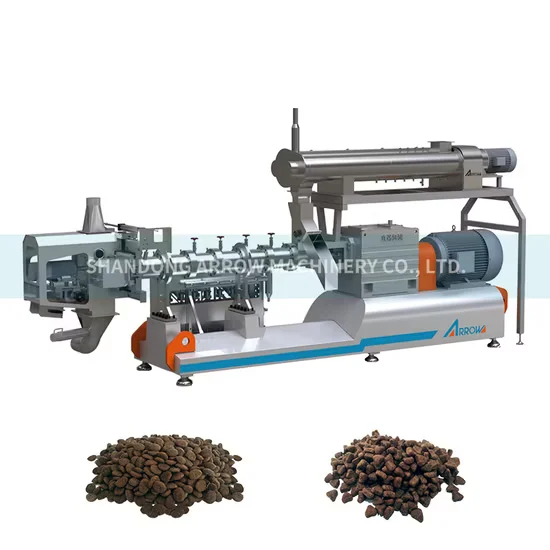 02
Dry Pet Food Production Line
Pet Food Production Line for Dog and Cat Kibble Manufacturing
View machine details 03
Dry Pet Food Production Line
Dog Kibble Production Line for Pet Food Process Equipment
View machine details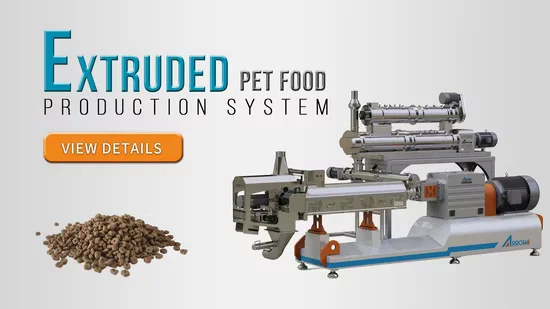 04
Dry Pet Food Production Line
Dry Kibble Pet Food Production Line for Dog and Cat
View machine detailsFurther Reading
Related extrusion process notes


Configured Quotation
Send your formula and capacity for a configured line proposal
Shandong Arrow Machinery engineers review your raw materials, product shape and kg/h or t/h target, then propose a single machine or complete pet food, aquafeed or specialty feed line.
- Emailinfo@arrowextrusion.com
- WhatsApp+86 137 9316 7756
- FactoryNo. 47 Chengbohu Road, Jibei Subdistrict, Jiyang District, Jinan, Shandong, China
Request a Quote
Payment by T/T, L/C or Alibaba Trade Assurance. Scope, delivery time and commissioning support are stated in the formal quotation.