
Extrusion Process Notes Brands & Alternatives
Cross-Flow Dryer vs Belt Dryer for Pet Food Kibble Drying
Uneven moisture in pet food kibble causes cracking and waste, making the choice between drying technologies critical for quality. Compare cross-flow and belt dryers to select the system that ensures uniform drying and thermal efficiency for your production line.

Pet food kibble exiting the dryer with uneven moisture levels is a production nightmare that leads to cracking, molding, and wasted batches. Selecting the wrong drying technology not only compromises product stability but also inflates energy costs significantly. Understanding the mechanical differences between drying systems is critical for maintaining consistent quality in high-volume manufacturing.
For most standard dry pet food applications, a cross-flow circulation dryer offers superior moisture uniformity and thermal efficiency compared to traditional belt dryers. While belt systems have their place in specific continuous processing scenarios, the cross-flow design better addresses the challenges of penetrating dense kibble structures without causing surface hardening. The final choice depends on your specific product density, factory footprint, and energy budget.
Airflow Mechanics: Penetration vs. Surface Exposure
The fundamental difference between these two technologies lies in how hot air interacts with the product bed. In a belt dryer, kibble is typically spread in a single or multi-layer mesh belt that moves through a heated chamber. Hot air usually flows from top to bottom or horizontally across the surface. This method relies heavily on convection at the particle surface. If the layer is too thick, the bottom pellets may remain under-dried while the top ones become over-processed.
In contrast, a cross-flow circulation dryer utilizes a vertical or angled airflow that penetrates through the falling or tumbling product column. As the kibble moves through the drying zone, it is often agitated or distributed in a way that exposes all surfaces to the heated air stream repeatedly. This penetration ensures that moisture migrates from the core to the surface more evenly. The turbulent nature of cross-flow systems helps break up boundary layers of humid air that can stall drying in static beds.
This mechanical distinction matters because extruded kibble often has a sealed outer crust formed during the expansion process. Surface-only heating can case-harden this crust, trapping internal moisture. Cross-flow designs mitigate this risk by ensuring consistent thermal exposure across the entire batch volume, which is vital for achieving target moisture levels below 10% without excessive residence times.
Moisture Consistency and Product Quality Impact
Inconsistent moisture content is the primary cause of post-packaging spoilage and texture defects in dry pet food. When using a belt dryer, variations in bed thickness or airflow distribution can create hot and cold spots. Pellets from hotter zones may become brittle and generate excessive fines during downstream handling, while those from cooler zones retain enough water activity to support microbial growth. For contract manufacturers producing multiple formulations, this variability increases the risk of cross-contamination and quality rejection.
Cross-flow dryers enhance consistency by promoting uniform heat transfer. The continuous mixing or tumbling action inherent in many cross-flow configurations ensures that each pellet experiences similar thermal conditions. This is particularly important for high-density kibble or products with significant fresh meat inclusion, where internal moisture migration is slower. By reducing the gradient between the surface and the core, these systems help maintain the structural integrity of the kibble, preserving its crunch and preventing premature fracturing.
Moreover, precise moisture control directly influences the effectiveness of subsequent coating stages. If kibble enters the vacuum coating or drum flavoring section with uneven moisture, fat absorption will be inconsistent. This leads to patchy seasoning and potential rancidity issues in high-fat areas. A stable drying profile provided by a cross-flow system ensures that the substrate is ready for uniform enrobing, which is essential for premium palatability standards.
Energy Efficiency and Footprint Considerations
Factory planning requires balancing throughput with operational costs. Belt dryers often require large floor spaces to achieve sufficient residence time, especially for low-temperature drying protocols needed to preserve heat-sensitive nutrients. Their linear design can make integration into compact facilities challenging. Additionally, maintaining uniform temperature across a wide belt width can demand significant energy input, as heat loss through the chamber walls and exhaust air can be substantial if not meticulously insulated and recirculated.
Cross-flow circulation dryers typically offer a more compact footprint relative to their capacity. The vertical or angled flow path allows for a taller, narrower design that fits better in facilities with height clearance but limited floor area. More importantly, these systems are designed for high thermal efficiency. By recirculating a portion of the exhaust air and optimizing the heat exchange within the product column, they reduce the total energy required per kilogram of water removed.
When evaluating options like the Cross-Flow Circulation Dryer or External Air Circulation Dryer from Arrow’s portfolio, consider the utility constraints of your site. These units are engineered to maximize heat recovery and minimize waste. For new factories or retrofits where space is at a premium, the modular nature of cross-flow systems allows for easier integration into existing extrusion lines without requiring extensive structural modifications. This efficiency translates to lower long-term operating costs, a critical factor for competitive manufacturing.
Matching the Dryer to Your Kibble Characteristics
Not all kibble is created equal, and the ideal dryer depends on your specific product parameters. Use the following considerations to guide your selection:
- Particle Density and Size: Dense, small-diameter pellets benefit from the penetrating airflow of cross-flow systems. Large, porous pieces may dry adequately on a belt but still gain consistency benefits from cross-flow agitation.
- Initial Moisture Content: High-moisture extrudates require efficient surface moisture removal followed by core drying. Cross-flow systems handle this transition smoothly by preventing surface sealing.
- Production Volume: For very high-capacity continuous lines, belt dryers can be scaled horizontally, but this increases footprint. Cross-flow units can be stacked or widened to match high throughput in a smaller area.
- Product Fragility: If your kibble is prone to breaking, evaluate the agitation level of the cross-flow system. Some designs use gentle tumbling, while others may require careful adjustment of air velocity to prevent attrition.
Ultimately, the decision should not be made in isolation. The drying stage must be balanced with the upstream extrusion and downstream coating capacities. A bottleneck in drying will limit the entire line’s output. Engaging with an engineering team that can model these interactions ensures that the selected dryer matches the extruder’s output and the coater’s intake requirements. Arrow’s approach involves reviewing your raw material formulation and target specifications to recommend the appropriate configuration, ensuring that the drying system supports rather than hinders your production goals.
Frequently Asked Questions
Q: Which dryer is more energy-efficient for drying high-moisture pet kibble?
A: Cross-flow circulation dryers generally offer higher thermal efficiency for high-moisture kibble due to their ability to recirculate heated air and penetrate the product bed effectively. This reduces the energy required to evaporate water compared to static belt systems, which may suffer from heat loss and uneven distribution. However, exact efficiency depends on insulation, airflow design, and operational parameters.
Q: Can a cross-flow dryer handle different kibble shapes and sizes without breaking them?
A: Yes, but the system must be configured correctly. Modern cross-flow dryers can be adjusted to control air velocity and product movement speed to minimize attrition. For fragile products, gentle handling mechanisms are essential. It is crucial to test your specific kibble shape and density to ensure the agitation level does not cause excessive breakage or fines generation during the drying process.
Q: How does the drying method affect the final shelf life of dry pet food?
A: Uniform moisture removal is critical for shelf life. Inconsistent drying leaves pockets of high water activity, which can lead to mold growth and lipid oxidation. Cross-flow dryers promote even drying throughout the kibble, reducing the risk of localized spoilage. This consistency ensures that the final product meets safety standards and maintains freshness longer, provided it is stored in appropriate conditions.
Q: Is it possible to integrate a cross-flow dryer into an existing extrusion line?
A: Yes, cross-flow dryers are often designed for modular integration. They can be connected to existing conveyors and cooling systems with minimal modification. However, proper alignment of capacity and airflow interfaces is necessary. An engineering assessment of your current line layout and utility availability is recommended to ensure smooth integration and optimal performance without disrupting existing workflows.
Send your kibble formula, particle dimensions, and target hourly capacity to receive a customized drying section technical specification and factory layout proposal. Our engineering team can also discuss raw material trials to validate the drying profile for your specific product before finalizing equipment selection.
Target Industries Covered in This Article
Equipment in This Process
Machines mentioned in this article
Each machine is built at the Shandong Arrow Machinery factory and supplied as a standalone unit or as part of a complete extrusion line.
 01
Dry Pet Food Production Line
Twin Screw Extruder Pet Food Freeze Dry Plant Equipment
View machine details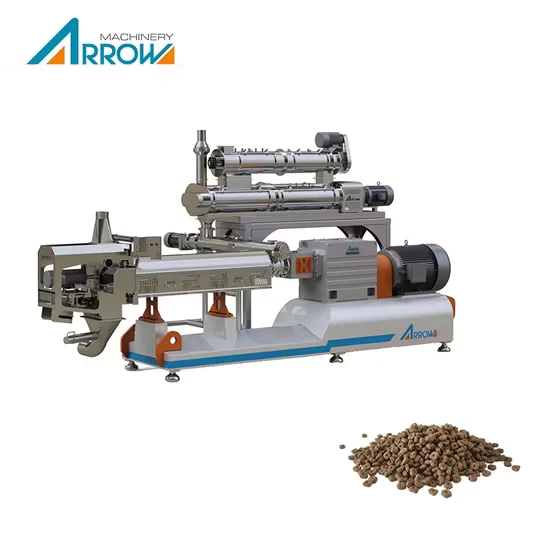 02
Dry Pet Food Production Line
Twin-Screw Extruder Equipment for Dry Kibble Pet Food Plant
View machine details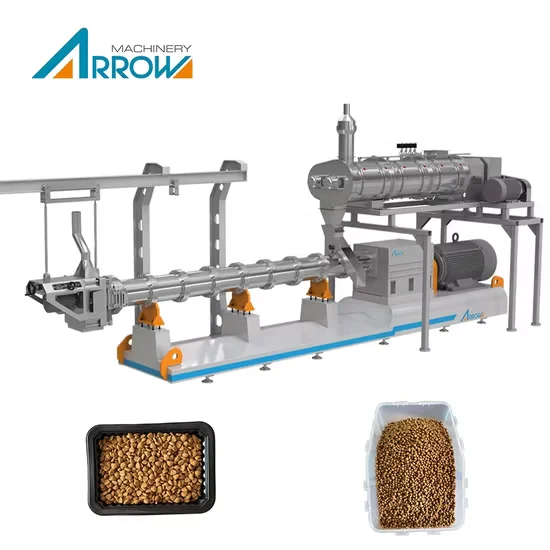 03
Dry Pet Food Production Line
Automatic Twin-Screw Extruder Pet Food Production Line
View machine details 04
Dry Pet Food Production Line
Twin-Screw Extruder for Dry Pet Food Production Plant
View machine detailsFurther Reading
Related extrusion process notes
· Brands & Alternatives· 7
Pet Food Extruder Choices: Arrow vs Alternative Brands
Read the article · Brands & Alternatives· 7
Enzymatic Hydrolysis Palatants Make or Buy Guide for Pet Food
Read the article
· Brands & Alternatives· 7
How to Switch from Bentonite to Starch-Based Cat Litter Production
Read the article
Configured Quotation
Send your formula and capacity for a configured line proposal
Shandong Arrow Machinery engineers review your raw materials, product shape and kg/h or t/h target, then propose a single machine or complete pet food, aquafeed or specialty feed line.
- Emailinfo@arrowextrusion.com
- WhatsApp+86 137 9316 7756
- FactoryNo. 47 Chengbohu Road, Jibei Subdistrict, Jiyang District, Jinan, Shandong, China
Request a Quote
Payment by T/T, L/C or Alibaba Trade Assurance. Scope, delivery time and commissioning support are stated in the formal quotation.