
Extrusion Process Notes Brands & Alternatives
Extruded vs Baked Kibble Lines and How to Choose the Right One
This guide resolves the critical choice between extrusion and baking for new pet food facilities by detailing how each method dictates capital expenditure and product characteristics. Readers learn to match their meat inclusion rates and texture goals with the right processing technology to prevent costly mismatches between recipe formulation and machine capability.
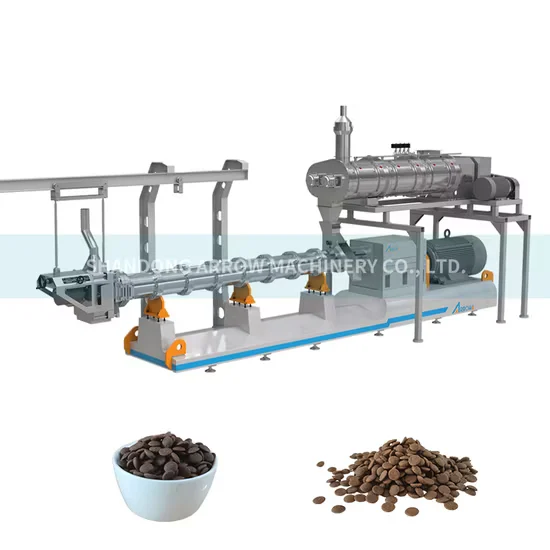
Many emerging pet food brands hesitate between extrusion and baking when planning a new facility, often overlooking how this choice dictates capital expenditure and final product characteristics. The decision is not merely about texture; it defines the entire engineering scope from raw material handling to final packaging.
The right choice depends on your specific meat inclusion rates, target shelf life, and thermal processing capabilities. Extrusion offers high throughput and consistent starch gelatinization for standard kibble, while baking supports higher fresh meat inclusions and a denser, crunchy texture but requires precise moisture control during drying. Understanding these trade-offs prevents costly mismatches between recipe formulation and machine capability.
Core Process Differences: High-Shear Extrusion vs. Low-Temperature Baking
Twin-screw extrusion relies on high pressure, temperature, and mechanical shear to cook and shape dough in seconds. The material passes through a barrel where rotating screws mix ingredients, apply friction, and force the mixture through a die. This rapid expansion creates a porous structure as moisture flashes off upon exit. In contrast, baked kibble production uses a forming machine to shape a softer dough, followed by a longer, lower-temperature cooking phase in an oven.
The thermal profiles differ significantly. Extrusion achieves near-complete starch gelatinization quickly, which aids digestibility but can degrade heat-sensitive nutrients if not carefully managed. Baking applies heat more gently over a longer period, potentially preserving certain nutrients better but requiring careful management of surface drying to prevent case hardening. The equipment mechanics also diverge: extruders need precise screw configuration to handle viscosity changes, while baking lines depend on uniform airflow and conveyor speed to ensure even cooking.
Product Texture, Shape, and Nutritional Profiles
Extruded kibble is characterized by its light, airy texture and high expansion ratio. This porosity makes it ideal for applications requiring high palatability through fat coating, as the internal structure absorbs flavors well. However, the high expansion limits the amount of fresh meat or liquid ingredients that can be included before the dough becomes too sticky to process. The resulting product is typically less dense and may float or sink depending on the formulation and extrusion parameters.
Baked kibble offers a denser, harder crunch with a more irregular, rustic appearance. Because the dough is not subjected to the same extreme pressure and shear, it can accommodate higher levels of fresh meat and fats without losing structural integrity during forming. This makes baking attractive for premium segments marketing high-protein, grain-free, or fresh-meat recipes. The texture is often described as more brittle or crunchy rather than airy, which some pets prefer for dental health benefits.
Moisture control is critical in both methods but presents different challenges. Extruded products exit the die with significant moisture that must be removed rapidly to prevent spoilage, while baked products lose moisture gradually during the cooking process. The final water activity level determines shelf life, and inconsistent drying can lead to mold growth or rancidity, a risk I encountered firsthand when scaling up a high-meat recipe without adequate drying capacity.
Equipment Configuration and Line Layout
A standard dry pet food extrusion line includes mixing, extrusion, pre-drying, coating, and final drying stages. The Twin-Screw Extruder is the heart of this system, requiring precise synchronization with upstream feeders and downstream cutters. Downstream, a Cross-Flow Circulation Dryer or External Air Circulation Dryer removes moisture efficiently. For high-fat formulas, a Vacuum Coating Machine ensures even flavor distribution without making the kibble greasy to the touch.
A baked kibble production line replaces the extruder with a Baked Pet Food Forming Machine and a multi-zone baking oven. The forming stage shapes the dough, which then travels through the oven on a conveyor. Post-baking, the product still requires drying to reach safe moisture levels, often using a GDH Series Dryer or similar low-temperature drying room to avoid overheating the already cooked product. Mixing and grinding systems remain similar, but the throughput balance shifts because baking cycles are longer than extrusion residence times.
Layout constraints play a major role in equipment selection. Extrusion lines are compact in the cooking section but require significant space for drying and cooling. Baking lines need extensive floor space for the oven and longer conveyors. Utilities also differ: extruders demand high electrical power for motors and heaters, while baking ovens may rely on gas or steam for thermal energy. Integrating these systems requires matching the capacity of each stage; a bottleneck in drying will limit the entire line’s output, regardless of the extruder or oven speed.
Matching the Production Method to Your Brand Strategy
Choosing between extruded and baked kibble lines should align with your brand’s value proposition and operational capabilities. If your goal is high-volume production of standard, highly digestible kibble with consistent shape and size, extrusion is the proven path. It offers flexibility in shape changes via die swaps and efficient energy use per ton of output. For brands targeting the premium segment with high fresh meat content, unique textures, or clean-label claims, baking provides a distinct market differentiation.
Consider your raw material sourcing and formulation stability. Extrusion handles variable ingredient quality well due to the intense mixing and cooking action, while baking requires more consistent dough rheology to prevent forming issues. If you plan to introduce frequent recipe changes or limited-edition flavors, evaluate how easily each system can be cleaned and adjusted. A comprehensive technical review, including raw material trials, helps validate whether your specific formula behaves as expected in the chosen equipment.
Shandong Arrow Machinery supports both pathways by offering complete production lines and individual machines configured to your specific utility and space constraints. Whether you need a standalone Twin-Screw Extruder for an existing line or a full turnkey baked kibble plant, the engineering team assesses your ingredient profile and capacity targets to recommend the optimal setup. This approach ensures that the equipment matches your process needs rather than forcing your recipe to fit a standard machine.
Frequently Asked Questions
Q: Can a single production line switch between extruded and baked kibble?
A: No, these are fundamentally different processes requiring distinct core machinery. Extrusion uses a twin-screw extruder for high-pressure cooking, while baking uses a forming machine and oven. You cannot convert one into the other without replacing the primary cooking and shaping equipment. However, upstream grinding and mixing systems may be shared if properly sized and cleaned between batches.
Q: Which process allows for higher inclusion rates of fresh meat?
A: Baking generally supports higher fresh meat inclusions because it does not rely on high-pressure expansion to form the kibble. The dough in baking is softer and shaped mechanically, allowing for more liquid and fat content without sticking or losing shape. Extrusion requires a drier, more stable dough to maintain pressure and shape through the die, limiting fresh meat addition unless specialized preconditioning is used.
Q: How do energy consumption and throughput compare between extrusion and baking lines?
A: Extrusion typically offers higher throughput per hour due to the continuous, rapid cooking process. Energy consumption varies based on utilities; extruders use significant electrical power, while baking ovens often use gas or steam. Overall, extrusion is often more energy-efficient per unit of output for standard kibble, but baking may justify higher costs for premium product positioning. Exact figures depend on specific machine models and local utility rates.
Q: What downstream equipment is required for coating and drying in both methods?
A: Both methods require drying to reduce moisture to safe levels. Extruded kibble often uses a Cross-Flow Circulation Dryer followed by a Vacuum Coating Machine for high-fat formulas. Baked kibble may use a GDH Series Dryer or drying room to gently remove residual moisture without overcooking. Coating systems like Single-Drum or Double-Drum Flavoring Machines can be used for both, but vacuum coating is preferred for high-fat absorption in extruded products.
Send your product formula, target capacity, and desired kibble characteristics to receive a customized technical proposal. Our engineering team can review your raw material profile and suggest whether an extrusion or baking line best fits your production goals, including detailed layout options and equipment specifications for your review.
Target Industries Covered in This Article
Equipment in This Process
Machines mentioned in this article
Each machine is built at the Shandong Arrow Machinery factory and supplied as a standalone unit or as part of a complete extrusion line.
01 Dry Pet Food Production Line
Twin Screw Pet Dog Cat Feed Extruded Processing Line
View machine details 02
Dry Pet Food Production Line
Dry Pet Food Manufacturing Line Extruded Plant Equipment
View machine details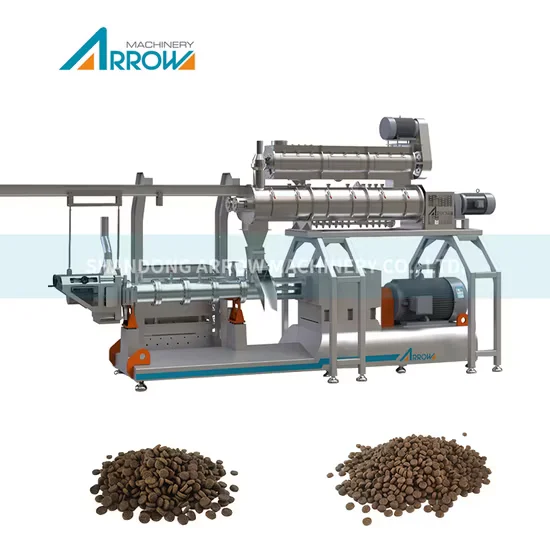 03
Dry Pet Food Production Line
Automatic Extruded Dog Pet Food Product Line Equipment
View machine details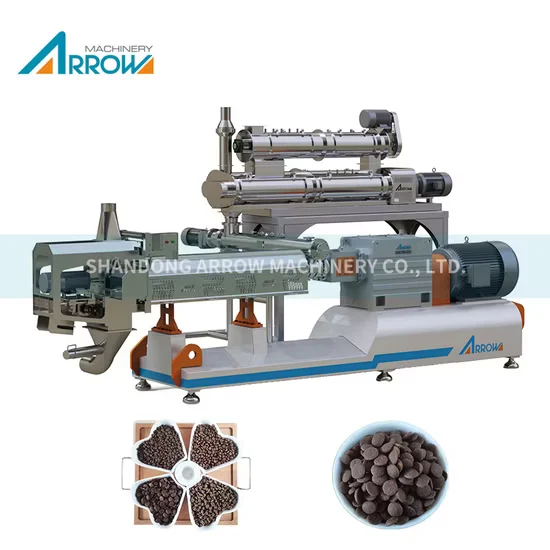 04
Dry Pet Food Production Line
Dry Extruded Pet Food Production Line Equipment for Dog
View machine detailsFurther Reading
Related extrusion process notes

· Brands & Alternatives· 7
Pet Food Extruder Choices: Arrow vs Alternative Brands
Read the article · Brands & Alternatives· 7
Enzymatic Hydrolysis Palatants Make or Buy Guide for Pet Food
Read the article
· Brands & Alternatives· 7
How to Switch from Bentonite to Starch-Based Cat Litter Production
Read the article
Configured Quotation
Send your formula and capacity for a configured line proposal
Shandong Arrow Machinery engineers review your raw materials, product shape and kg/h or t/h target, then propose a single machine or complete pet food, aquafeed or specialty feed line.
- Emailinfo@arrowextrusion.com
- WhatsApp+86 137 9316 7756
- FactoryNo. 47 Chengbohu Road, Jibei Subdistrict, Jiyang District, Jinan, Shandong, China
Request a Quote
Payment by T/T, L/C or Alibaba Trade Assurance. Scope, delivery time and commissioning support are stated in the formal quotation.