
Extrusion Process Notes Brands & Alternatives
Pet Extruders: 3 Differences Between Manufacturers and Trading Companies
This article clarifies the critical differences between a pet extruder manufacturer and a trading company regarding process stability and hidden costs. Readers learn to verify source factories through recipe testing capabilities and direct engineering support for reliable production lines.

When a trading company lures you with a glossy catalog and a low down payment, they often cannot explain how your high-fresh-meat formula requires specific temperature profiles and shear forces inside a twin-screw barrel. You learn quickly that when a production line fails to balance overseas, a middleman cannot fix it with a phone call. The real distinction between a pet extruder manufacturer vs trading company lies not in the brochure, but in who holds the engineering keys to your process stability.
Sourcing from a source factory provides direct access to process testing, integrated line balancing, and accountable after-sales support. Trading firms typically assemble standalone machines from various suppliers, lacking the capability to validate recipe behavior or guarantee that upstream mixing matches downstream drying capacity. For investors planning new facilities, this difference determines whether you receive a working production system or a collection of mismatched machines.
The Real Cost Difference: Factory-Direct Transparency vs. Hidden Middleman Margins
The initial quote is rarely the final cost. Trading companies operate by adding margins to equipment sourced from multiple factories, often obscuring the true value of individual components. This structure creates hidden costs in communication delays and technical misalignment. When you buy from a source manufacturer, the pricing reflects direct production costs and integrated engineering services. You avoid the layered markups that occur when a third party manages the supply chain without adding technical value.
Source manufacturers like Arrow leverage large-scale production and supply chain integration to offer transparent ex-works pricing. This transparency allows buyers to allocate budget toward critical automation upgrades or higher-grade materials rather than paying for intermediary overhead. In contrast, trading firms may cut corners on component quality to preserve their margin, leading to higher maintenance costs later. Understanding the pet extruder manufacturer vs trading company dynamic helps you see that a slightly higher initial quote from a factory often includes essential engineering validation that a trader excludes.
With the same budget, purchasing directly from a factory often yields better equipment configurations. You might secure a more advanced control system or a heavier-duty gearbox because the money goes into the machine, not the middleman’s profit. This financial efficiency is crucial for projects where every dollar must contribute to throughput reliability and product consistency.
Process Engineering and Recipe Testing: Why Source Factories Ensure Consistency
A recipe that works in a laboratory bench-top extruder often behaves differently in full-scale production. Trading companies usually lack in-house testing platforms, meaning they cannot verify how your specific ingredient ratios interact with their proposed equipment. They may promise performance based on generic data, leaving you to troubleshoot formulation issues after installation. Source manufacturers, however, possess dedicated extrusion-process testing platforms.
At Arrow, engineers assess raw materials and process requirements before specifying an extrusion system. This pre-sales testing confirms screw configuration, temperature curves, and moisture control strategies tailored to your formula. For instance, high-fat diets or formulas with significant fresh meat content require precise shear management to prevent slippage or uneven expansion. Without this validation, you risk inconsistent kibble density and poor texture.
The integration of upstream and downstream processes is equally vital. A twin-screw extruder must match the output of the mixer and the capacity of the dryer. If the grinder produces uneven particle sizes, the extrusion stability suffers. Source factories evaluate the entire chain, from grinding and mixing to drying and coating. This holistic approach ensures that the Cross-Flow Circulation Dryer can handle the moisture load from the extruder without creating bottlenecks. Trading firms often sell these units as standalone items, ignoring the dynamic interplay between them.
Customization, Integration, and Turnkey Plant Layouts
Every factory has unique constraints regarding footprint, ceiling height, and utility availability. Trading companies typically offer standard, one-size-fits-all machine packages that may not fit your existing building or optimize workflow. They lack the engineering depth to redesign layouts for efficient material flow and maintenance access. Source manufacturers provide custom line layouts and equipment configuration based on your specific site dimensions and process capacity.
For example, a wet food meat chunks line requires different forming and sterilization parameters than a dry kibble line. A source factory can engineer a Vacuum Coating Machine to integrate smoothly with the cooling conveyor, ensuring even flavor distribution without damaging the pellet structure. This level of customization extends to turnkey plant solutions, where the supplier manages the scope from civil work coordination to final commissioning.
When you compare a pet extruder manufacturer vs trading company, look for evidence of engineered integration. Can they show you how the screw profile changes for sinking fish feed versus floating feed? Do they adjust the cutter speed and air knife pressure based on your target bulk density? Source factories treat the production line as a single organism, adjusting each organ to support the whole. Traders treat it as a shopping list.
After-Sales Support, Spare Parts, and Overseas Commissioning
Equipment failure in an overseas factory is a crisis. If you bought from a trading company, you become the messenger between your local technician and the distant factory. The trader may blame the installer, the installer may blame the machine, and days of production are lost. Source manufacturers eliminate this finger-pointing by taking direct responsibility for installation, commissioning, and training.
Arrow supports overseas projects with defined scopes for engineering teams, travel, and technical support. This direct line of communication ensures that spare parts are identified correctly and shipped promptly. You can specify installation responsibilities and training protocols in the contract, knowing that the people who built the machine are the ones teaching your team how to run it. This accountability is absent in most trading arrangements.
Furthermore, long-term spare parts availability is critical. Source factories maintain inventory for their specific models, ensuring compatibility for years. Trading firms may switch suppliers, leaving you with obsolete parts no one else stocks. When evaluating a pet extruder manufacturer vs trading company, prioritize partners who commit to post-sale technical support and clear spare-parts arrangements in the initial agreement.
Frequently Asked Questions
Q: How can I verify if a Chinese pet extruder supplier is a real manufacturer or a trading company?
A: Request a live video tour of the production floor, specifically asking to see the machining center and assembly area for extruder barrels and screws. Ask for the business license and check if the scope includes manufacturing. Real manufacturers will readily share details about their R&D team and testing platform, while traders often hesitate or provide generic office photos.
Q: Can a trading company provide the same technical support and recipe testing as a source factory?
A: Generally, no. Trading companies do not own the machinery or the engineering team required for recipe trials. They rely on external factories for technical answers, which causes delays. Source factories have in-house engineers who can test your specific raw materials and adjust screw configurations before shipment, ensuring the process works for your formula.
Q: What are the risks of buying a complete pet food production line from a middleman?
A: The primary risk is mismatched equipment capacity. A trader may pair an extruder with a dryer that cannot handle the moisture output, creating a bottleneck. Additionally, warranty claims become complicated as the trader acts as a buffer. You may face longer downtime waiting for parts or technical advice, as the trader lacks direct control over the manufacturing and engineering resources.
Q: Does a source manufacturer offer better customization for specific pet food or aquafeed formulas?
A: Yes. Source manufacturers can modify screw elements, barrel lengths, and die designs to suit specific ingredients like high-protein meats or alternative starches. They understand how shear and temperature affect product buoyancy and texture. This engineering flexibility allows for precise adjustments that trading companies, who sell standard catalog items, cannot provide.
Send your product formula, required capacity, and factory dimensions to receive a customized production line layout and technical specifications. Discuss your raw material characteristics with our engineering team to schedule a process trial and ensure your equipment is configured for optimal stability and output.
Target Industries Covered in This Article
Equipment in This Process
Machines mentioned in this article
Each machine is built at the Shandong Arrow Machinery factory and supplied as a standalone unit or as part of a complete extrusion line.
01 Dry Pet Food Production Line
Twin Screw Extruder Pet Food Freeze Dry Plant Equipment
View machine details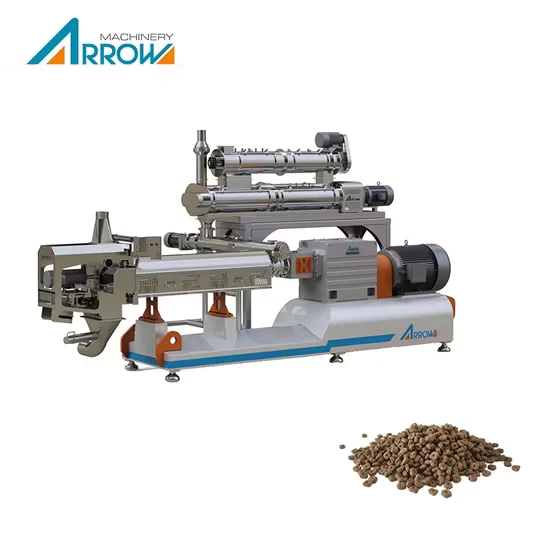 02
Dry Pet Food Production Line
Twin-Screw Extruder Equipment for Dry Kibble Pet Food Plant
View machine details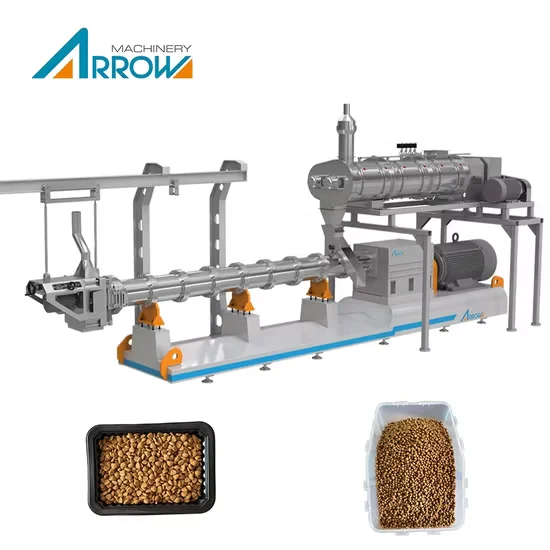 03
Dry Pet Food Production Line
Automatic Twin-Screw Extruder Pet Food Production Line
View machine details 04
Dry Pet Food Production Line
Dry Dog Food Production Extruder for Pet Equipment
View machine detailsFurther Reading
Related extrusion process notes
· Brands & Alternatives· 7
Pet Food Extruder Choices: Arrow vs Alternative Brands
Read the article · Brands & Alternatives· 7
Enzymatic Hydrolysis Palatants Make or Buy Guide for Pet Food
Read the article
· Brands & Alternatives· 7
How to Switch from Bentonite to Starch-Based Cat Litter Production
Read the article
Configured Quotation
Send your formula and capacity for a configured line proposal
Shandong Arrow Machinery engineers review your raw materials, product shape and kg/h or t/h target, then propose a single machine or complete pet food, aquafeed or specialty feed line.
- Emailinfo@arrowextrusion.com
- WhatsApp+86 137 9316 7756
- FactoryNo. 47 Chengbohu Road, Jibei Subdistrict, Jiyang District, Jinan, Shandong, China
Request a Quote
Payment by T/T, L/C or Alibaba Trade Assurance. Scope, delivery time and commissioning support are stated in the formal quotation.