Many investors planning a new facility allocate the bulk of their budget to the main extruder, assuming it dictates the entire success of the operation. Yet, in practical production, the drying curve and coating uniformity often become the true bottlenecks that determine the final texture and palatability of meat strips and chews. Ignoring these downstream processes can lead to inconsistent moisture levels, brittle products, or poor flavor retention, regardless of how advanced the forming equipment is.
The core of a successful pet treat production line lies not in maximizing the rotational speed of a single machine, but in systematically matching the twin-screw extrusion profile, low-temperature drying logic, and vacuum coating capabilities to the specific raw material characteristics. High fresh meat inclusion rates and desired chewiness require precise control over shear, thermal history, and moisture removal, which demands an integrated engineering approach rather than isolated equipment purchases.
Decoding the Process Flow for Jerky and Dog Chews
Producing high-quality jerky and dental chews begins long before the material enters the die. The initial stages involve grinding and mixing raw materials, where particle size consistency is critical for uniform hydration and cooking. When dealing with formulations that include significant amounts of fresh meat or high-fat ingredients, the homogeneity of the mixture directly impacts the stability of the extrusion process. Inconsistent particle sizes can lead to uneven cooking, resulting in products with variable textures or structural weaknesses.
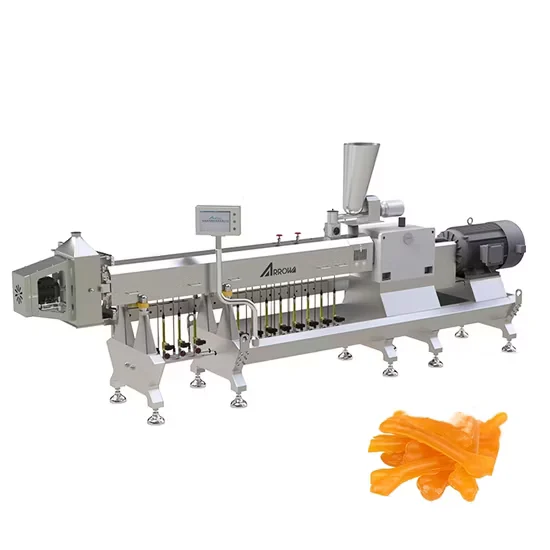
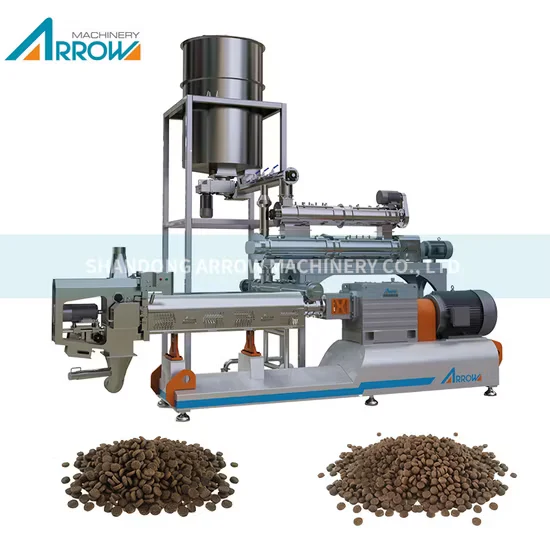
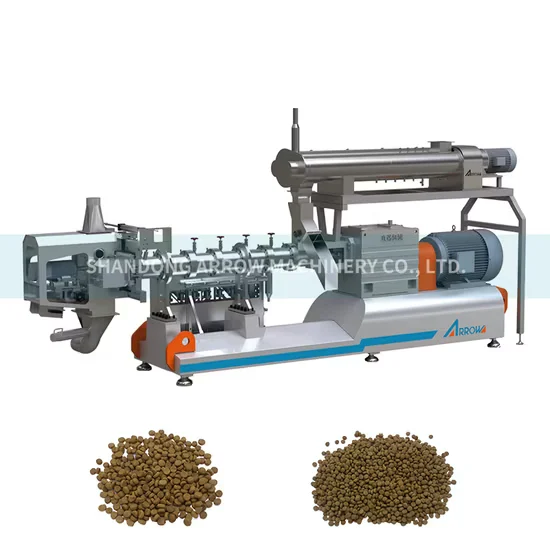
The heart of the forming process is the extrusion system. For applications requiring high flexibility in recipe formulation, such as switching between soft meat jerky and dense dental chews, a twin-screw configuration offers distinct advantages over single-screw alternatives. The intermeshing screws provide superior conveying efficiency and self-cleaning properties, which are essential when handling sticky, high-moisture doughs. This setup allows for precise control over the mechanical energy input, enabling manufacturers to achieve the desired degree of starch gelatinization and protein denaturation without excessive thermal degradation.
Furthermore, the ability to adjust barrel temperatures across multiple zones allows operators to manage the viscosity of the melt accurately. This control is vital for maintaining the structural integrity of complex shapes, such as twisted chews or hollow sticks, which are prone to collapsing if the material is too fluid or cracking if it is too rigid. The versatility of the twin-screw system ensures that the line can adapt to various product specifications without requiring complete hardware overhauls, making it a suitable choice for facilities aiming to produce a diverse portfolio of snacks.
Critical Equipment Selection for Texture and Shape
Selecting the right forming technology depends heavily on the target texture of the final product. For traditional jerky and soft chews, the goal is often to create a dense, fibrous structure that mimics real meat. In these cases, a low-temperature cold extruder is frequently employed. Unlike standard high-temperature extrusion that causes significant puffing, cold extrusion focuses on shaping and mild cooking, preserving the natural color and heat-sensitive nutrients of the ingredients. This method is particularly effective for products where a dense, non-porous texture is desired.
Conversely, producing hard dental chews or baked-style treats may require different thermal profiles and screw configurations. The choice of die plate and cutter speed also plays a pivotal role in defining the product’s dimensions and surface characteristics. For instance, achieving a smooth surface on a meat strip requires precise control over the exit pressure and cutting mechanism to prevent tearing or deformation. Operators must balance the moisture content of the dough with the mechanical shear applied during forming to ensure that the product holds its shape immediately after exiting the die.
When evaluating equipment for a jerky and chew line, it is essential to consider the ease of changeover between different product types. Modular screw elements and quick-release die heads can significantly reduce downtime during product switches. Additionally, the feeding system must be capable of handling varying bulk densities, especially when incorporating large proportions of fresh meat or liquid fats. A well-designed feeder ensures a consistent mass flow into the extruder barrel, which is fundamental for maintaining steady state operations and consistent product quality.
Drying and Coating: The Hidden Drivers of Quality
Once the products are formed, the drying stage becomes the most critical determinant of shelf life and texture. Removing moisture from dense meat strips or thick chews requires a careful balance between temperature and airflow to prevent case hardening, where the exterior dries too quickly and traps moisture inside. This phenomenon can lead to microbial spoilage or undesirable texture changes during storage. Cross-flow circulation dryers are often preferred for these applications because they provide uniform air distribution across the product bed, ensuring consistent drying rates throughout the batch.
The drying profile must be customized based on the product thickness and initial moisture content. For thicker chews, a multi-stage drying approach with gradually decreasing temperatures may be necessary to allow internal moisture to migrate to the surface without damaging the outer layer. This process requires precise monitoring and control systems to adjust airflow and heat input in real time. Failure to optimize this stage can result in products that are either too brittle or too soft, failing to meet the desired chewing resistance.
After drying, the coating process adds the final layer of palatability and functional benefits. Vacuum coating machines are ideal for applying high-viscosity fats, oils, or liquid flavors evenly onto the surface of irregularly shaped chews. The vacuum environment helps draw the coating into the microscopic pores of the product, ensuring strong adhesion and preventing rub-off during packaging and handling. For simpler surface seasoning, rotary drum flavoring machines can provide a quick and efficient application of dry powders or light sprays. Integrating these coating systems seamlessly with the dryer output ensures a continuous flow and minimizes product handling, reducing the risk of breakage.
Scaling Up: Line Integration and Plant Layout
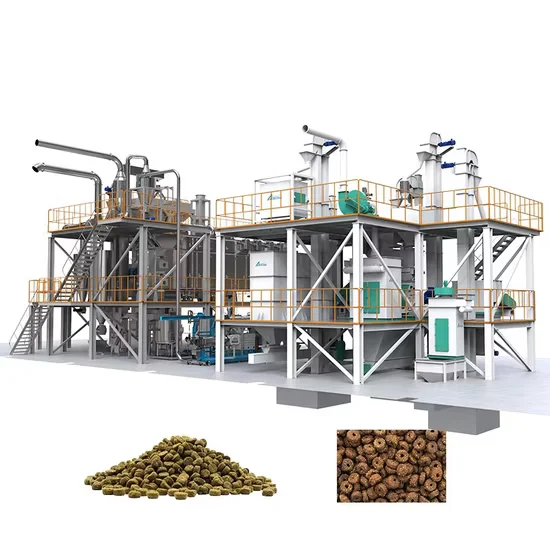
Transitioning from pilot-scale trials to full-scale production involves more than just buying larger machines. It requires a holistic view of the entire pet treat production line to ensure that each section operates in harmony. A common mistake is sizing the extruder for maximum output while neglecting the capacity of the downstream drying and cooling sections. Since drying is typically the slowest process in the chain, it often becomes the bottleneck that limits the overall throughput of the plant. Properly balancing these capacities is crucial for achieving efficient utilization of all equipment.
Plant layout also plays a significant role in operational efficiency and hygiene. Designing the flow of materials to minimize vertical lifts and horizontal transfers reduces the risk of product degradation and contamination. Adequate space must be allocated around key machines for maintenance access and cleaning operations. For facilities with space constraints or those planning phased expansions, modular design principles allow for the addition of extra drying racks or coating units without disrupting the existing workflow.
Engineering support during the planning phase can help identify potential integration issues before they arise. By providing detailed layout drawings and utility requirements early in the project, manufacturers can ensure that power, steam, and compressed air supplies are correctly positioned. This proactive approach facilitates smoother installation and commissioning, reducing the time required to reach full production capacity. Furthermore, having a single source for the entire line simplifies responsibility for performance guarantees and technical support, providing greater peace of mind for investors.
Frequently Asked Questions
Q: Can the same extruder produce both soft meat jerky and hard dental chews?
A: Yes, a twin-screw extruder can handle both applications by adjusting the screw configuration, barrel temperature profile, and die design. Soft jerky typically requires lower shear and temperature to maintain density, while hard chews may need higher mechanical energy for proper texturization. However, switching between these distinct product types may require some downtime for reconfiguration and cleaning to prevent cross-contamination of flavors or textures.
Q: How do you ensure consistent moisture levels in meat strips without making them too brittle?
A: Consistent moisture control relies on a precisely managed drying curve that matches the product’s thickness and composition. Using a cross-flow dryer with adjustable airflow and temperature zones allows for gentle moisture removal, preventing case hardening. Monitoring the exit moisture content with inline sensors and adjusting the drying time accordingly helps maintain the desired flexibility and chewiness, ensuring the product remains stable without becoming overly dry or brittle.
Q: What is the typical lead time and installation support for a complete pet treat production line?
A: Lead times vary based on the complexity of the configuration and current production schedules, so a formal quotation is necessary for accurate timelines. Installation support typically includes remote guidance and optional on-site commissioning by engineering teams. The scope of training, spare parts supply, and specific service levels should be defined in the contract to ensure clarity regarding responsibilities and expectations during the startup phase.
Q: Can the line handle high fresh meat inclusion rates without compromising pellet shape?
A: High fresh meat inclusion is feasible but requires careful management of the formulation and extrusion parameters. The twin-screw system’s mixing capability helps incorporate fresh meat uniformly, but the increased moisture and fat content may affect the structural integrity of the extrudate. Adjusting the screw profile to provide adequate conveying and pressure build-up, along with optimizing the die temperature, helps maintain shape stability. Trial runs are recommended to fine-tune these settings for specific recipes.
Send your target product formula, expected capacity in kg/h, and factory dimensions to receive a customized technical proposal and equipment layout from our engineering team. We can also discuss raw material trials to validate the process before finalizing your investment.