
Extrusion Process Notes Brands & Alternatives
Solve Pet Food Drying Needs: GDH Series vs Belt Dryer
This guide compares the GDH series dryer and belt dryers to solve pet food drying challenges related to spatial efficiency and airflow dynamics. Readers learn to select the optimal system by evaluating product density, moisture targets, and plant layout constraints for better operational performance.

Choosing the right dryer for your pet food line isn’t just about nominal capacity—it’s about matching the heat transfer method to your specific kibble shape and moisture target to avoid hidden energy waste. Many producers discover too late that a mismatched drying system creates bottlenecks, leading to inconsistent moisture levels that ruin downstream coating processes and spike operational costs.
The core distinction lies in spatial efficiency and airflow dynamics. The GDH series dryer utilizes a multi-layer structure with cross-flow circulation, making it ideal for small to medium-sized facilities with limited floor space or specific thermal profiles for dense kibble. In contrast, traditional belt dryers excel in ultra-high-capacity continuous lines where horizontal footprint is less constrained than vertical height limitations. Selecting between them requires a precise evaluation of your product’s density, target moisture content, and existing plant layout.
Thermal Dynamics: Cross-Flow Circulation vs. Linear Air Penetration
Understanding how heat interacts with your product is critical for maintaining structural integrity and nutritional value. The GDH series dryer operates on a principle of layered material movement combined with cross-flow air circulation. Hot air penetrates the product bed from multiple directions as trays or layers shift, ensuring that each particle receives uniform exposure. This method reduces the risk of surface hardening, a common issue where the exterior dries too quickly while the interior retains excess moisture.
Conversely, standard belt dryers typically rely on linear airflow, either passing through a single thick layer or across multiple parallel belts. While effective for large volumes, this approach can struggle with uneven distribution if the product bed is not perfectly leveled. Variations in kibble size or density can create channels where air bypasses denser clusters, leading to inconsistent final moisture levels. For products requiring precise moisture control to prevent mold or ensure coating adhesion, the multidirectional airflow of the GDH series offers a distinct advantage in uniformity.
When evaluating pet food drying equipment, consider the thermal sensitivity of your formulation. High-meat content recipes or those with delicate vitamin premixes benefit from the controlled, gradual moisture removal facilitated by cross-flow systems. This gentle yet efficient heat transfer helps preserve ingredient integrity while achieving the necessary water activity reduction for shelf stability.
Spatial Constraints and Plant Layout Optimization
Factory footprint is often the deciding factor in equipment selection, especially for retrofitting projects or facilities in urban industrial zones. The GDH series dryer is engineered to maximize vertical space, stacking drying chambers to achieve significant throughput within a compact base area. This design allows production managers to integrate high-capacity drying into existing buildings without extensive structural modifications or costly expansions. It is particularly suitable for plants where floor space is at a premium but ceiling height permits vertical installation.
Belt dryers, by nature, require a longer horizontal footprint to provide sufficient residence time for the product. While multi-tier belt systems exist, they often demand complex support structures and extensive maintenance access points along their length. For new greenfield projects with ample land, a belt dryer may fit seamlessly into a linear process flow. However, for facilities aiming to optimize every square meter, the vertical integration of the GDH series provides a more flexible solution.
Integrating a dryer into your line also involves considering upstream and downstream connections. The compact nature of the GDH series allows for tighter coupling with extruders and coaters, reducing the need for long conveyors that can cause product degradation. When planning your layout, map out not just the machine dimensions but also the service aisles required for cleaning and maintenance. A well-planned layout ensures that operators can access all critical components without disrupting adjacent processes.
Product Compatibility and Gentle Handling
Different pet food formats present unique challenges during the drying phase. Standard kibble, with its relatively uniform shape and density, handles well in both systems. However, specialty treats, such as meat strips or irregularly shaped chews, require careful handling to prevent breakage or deformation. The GDH series dryer’s layered movement can be adjusted to minimize mechanical stress, making it suitable for fragile products that might crack under the weight of a deep bed in a belt dryer.
For wet food processing lines producing meat chunks or high-moisture snacks, controlling the drying rate is essential to maintain texture. Rapid surface drying can lead to a tough exterior that traps moisture inside, causing spoilage risks later. The cross-flow design allows for more precise control over the drying curve, enabling processors to match the thermal profile to the specific density and composition of their product. This flexibility is crucial when switching between different formulations or product sizes.
Aquafeed production also benefits from precise drying control. Floating fish feed requires a specific internal structure to maintain buoyancy, which can be compromised by aggressive drying methods. The gentle, uniform heat distribution of the GDH series helps preserve the porous structure created during extrusion, ensuring consistent floating performance. Sinking feeds, which are denser, also require thorough drying to prevent microbial growth, a task well-suited to the thorough penetration capabilities of cross-flow systems.
Energy Efficiency and Operational Cost Implications
Energy consumption is a major component of operating costs in pet food manufacturing. The GDH series dryer is designed with heat recovery and efficient air circulation in mind. By recirculating heated air and optimizing the flow path, these systems reduce the total energy required to evaporate moisture compared to open-loop or less efficient linear systems. This efficiency becomes increasingly significant as fuel and electricity prices fluctuate, directly impacting the bottom line.
While belt dryers can be efficient at very large scales due to economies of scale, they often suffer from heat loss along their extensive length. Insulation and sealing become critical maintenance items to prevent energy waste. The compact design of the GDH series minimizes surface area relative to volume, reducing inherent heat loss. Additionally, the ability to precisely control airflow means less energy is wasted on overheating or over-drying product, further enhancing operational efficiency.
Maintenance requirements also differ between the two types. Belt dryers involve numerous moving parts, including rollers, tensioners, and long conveyor belts that require regular inspection and replacement. The GDH series, with its simpler mechanical movement and modular chamber design, often presents lower long-term maintenance burdens. Fewer moving parts mean less wear and tear, translating to reduced downtime and spare parts inventory costs.
Frequently Asked Questions
Q: Can the GDH series dryer handle high-moisture pet treats without clumping?
A: Yes, the GDH series is designed to handle various moisture levels effectively. Its cross-flow air circulation ensures even drying, reducing the risk of clumping by preventing surface stickiness from uneven moisture gradients. Proper tray loading and airflow settings are key to maintaining product separation during the drying process.
Q: How does the cross-flow air circulation in the GDH dryer improve drying uniformity compared to a standard belt dryer?
A: Cross-flow circulation directs hot air through the product bed from multiple angles, ensuring all particles are exposed to consistent heat. This contrasts with linear airflow in belt dryers, which can create channeling issues. The result is a more uniform final moisture content, critical for product quality and shelf life.
Q: Which dryer is more suitable for a small to medium-sized pet food factory with limited floor space?
A: The GDH series dryer is typically more suitable for facilities with limited floor space. Its vertical, multi-layer design maximizes throughput within a compact footprint, allowing for efficient use of available area. Belt dryers generally require more horizontal space, making them better suited for larger plants with ample room.
Q: What is the typical maintenance difference between a multi-layer GDH dryer and a continuous belt dryer?
A: GDH dryers generally have fewer moving parts, such as long conveyor belts and numerous rollers, which reduces mechanical wear. Maintenance often focuses on airflow filters and chamber cleaning. Belt dryers require regular inspection and replacement of belts, rollers, and tensioning systems, potentially leading to higher long-term maintenance efforts.
To determine the optimal drying solution for your specific production needs, share your product formula, target moisture content, and expected capacity. Our engineering team will provide a customized technical specification sheet and plant layout proposal, ensuring your drying section integrates seamlessly with your extrusion and coating processes.
Equipment in This Process
Machines mentioned in this article
Each machine is built at the Shandong Arrow Machinery factory and supplied as a standalone unit or as part of a complete extrusion line.
01 Cross-Flow Circulation Dryer
Arrow Cross Circulation Dryer Equipment for Pet Feed
View machine details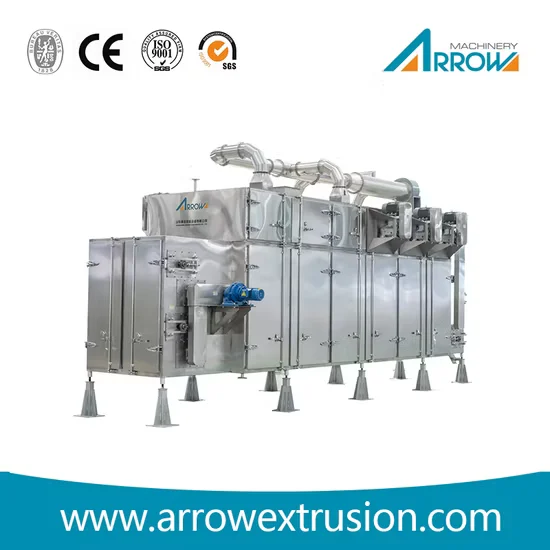 02
Drying System
Pet Food Production Dryer Equipment for Pet Food Plant
View machine details 03
Dry Pet Food Production Line
Twin Screw Extruder Pet Food Freeze Dry Plant Equipment
View machine details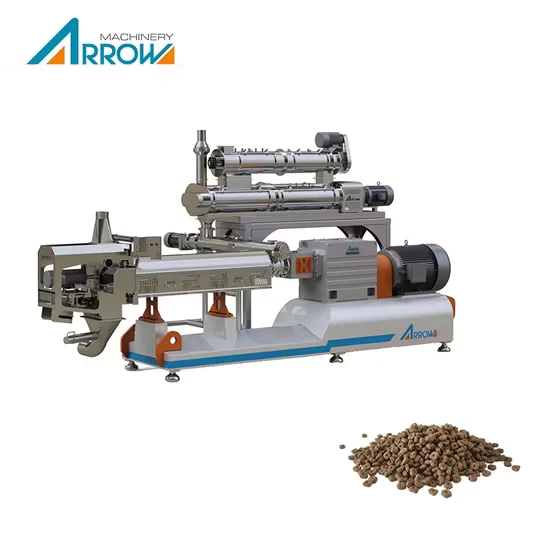 04
Dry Pet Food Production Line
Twin-Screw Extruder Equipment for Dry Kibble Pet Food Plant
View machine detailsFurther Reading
Related extrusion process notes
· Brands & Alternatives· 7
Pet Food Extruder Choices: Arrow vs Alternative Brands
Read the article · Brands & Alternatives· 7
Enzymatic Hydrolysis Palatants Make or Buy Guide for Pet Food
Read the article
· Brands & Alternatives· 7
How to Switch from Bentonite to Starch-Based Cat Litter Production
Read the article
Configured Quotation
Send your formula and capacity for a configured line proposal
Shandong Arrow Machinery engineers review your raw materials, product shape and kg/h or t/h target, then propose a single machine or complete pet food, aquafeed or specialty feed line.
- Emailinfo@arrowextrusion.com
- WhatsApp+86 137 9316 7756
- FactoryNo. 47 Chengbohu Road, Jibei Subdistrict, Jiyang District, Jinan, Shandong, China
Request a Quote
Payment by T/T, L/C or Alibaba Trade Assurance. Scope, delivery time and commissioning support are stated in the formal quotation.