
Extrusion Process Notes Brands & Alternatives
Solving Coating Issues: Drum Flavoring vs Vacuum Systems for Dog Kibble
This article resolves greasy surfaces and uneven coating in high-end dog kibble by comparing drum flavoring with vacuum systems. Readers learn to select the right pet food coating equipment based on fat inclusion levels and oxidation risks for premium diets.

High-end dog kibble constantly suffering from greasy surfaces or uneven coating? Choosing the wrong spraying equipment not only wastes expensive fats and palatability enhancers but also directly shortens product shelf life. The core distinction lies in physics: drum flavoring suits surface attachment of basic powders and low-viscosity oils, while vacuum coating enables deep lipid penetration into the kibble matrix, solving oxidation issues for high-fat diets.
Mechanics of Drum Flavoring for Standard Coating Applications
Drum flavoring machines operate on a straightforward mechanical principle. Kibble tumbles inside a rotating cylinder while liquid or powder additives are sprayed or dusted onto the moving bed. This method relies on gravity and friction to distribute the coating. For standard dry pet food with moderate fat inclusion levels, this approach is efficient and cost-effective. The Single-Drum Flavoring Machine and Double-Drum Flavoring Machine are designed to handle these baseline requirements, ensuring that surface-level attractants adhere uniformly without complex pressure systems.
However, the physical limits of atmospheric pressure become apparent when dealing with high-viscosity liquids or high fat ratios. In a standard drum, the oil sits on the surface of the pellet. If the fat content exceeds the absorption capacity of the outer crust, it remains free on the surface. This leads to the familiar issue of kibble sticking together in bags or leaving grease stains on packaging. Furthermore, heat-sensitive ingredients added during this stage may degrade if the kibble temperature is not carefully managed post-drying, as there is no protective environment to shield them during application.
When selecting a drum flavoring machine, consider your target fat inclusion. If your formulation requires less than 10-12% total fat and primarily uses dry powders for palatability, a drum system provides reliable throughput. It is also easier to clean between batches compared to more complex vacuum chambers, making it suitable for facilities running frequent SKU changes with similar base recipes. The key is matching the drum size and rotation speed to your line’s hourly output to ensure sufficient contact time for even distribution.
The Vacuum Coating Advantage for High-Fat Premium Diets
Vacuum coating technology addresses the limitations of atmospheric application by altering the pressure environment. By creating a negative pressure chamber, the air trapped within the porous structure of the extruded kibble is removed. When the vacuum is released and the coating fluid is introduced, the pressure differential forces the liquid deep into the internal pores of the pellet. This results in a dry-to-the-touch surface even with high fat inclusions, significantly improving handling and packaging stability.
This process is critical for premium and prescription diets where fat levels often exceed 15-20%. Surface-only coating would result in unacceptable rancidity rates due to oxygen exposure. By locking the lipids inside the kibble matrix, a Vacuum Coating Machine minimizes oxidation, thereby extending shelf life without excessive use of synthetic antioxidants. Additionally, this method allows for the uniform application of heat-sensitive liquids, such as certain probiotics or enzymatic hydrolysates, which might degrade under the mechanical stress and ambient exposure of traditional drum tumbling.
The operational workflow involves loading dried kibble into the chamber, pulling a vacuum, injecting the precise amount of coating agent, and then restoring atmospheric pressure. This cycle ensures that every pellet receives an identical dose, eliminating the hot spots and cold spots common in rotary drums. For manufacturers targeting the super-premium segment, this consistency is not just a quality metric but a brand promise. The ability to handle viscous oils and liquid proteins without clogging nozzles or creating clumps makes vacuum systems indispensable for advanced formulations.
Matching the Coating System to Your Product Goals
Choosing between drum and vacuum systems requires a clear understanding of your product roadmap. It is not merely a budget decision but a technical necessity driven by ingredient behavior. Below is a comparison to help guide your selection based on typical production scenarios.
| Feature | Drum Flavoring | Vacuum Coating |
|---|---|---|
| Fat Inclusion Capacity | Low to Moderate (<12%) | High (>15-20%) |
| Coating Location | Surface only | Internal pores + Surface |
| Viscosity Tolerance | Low viscosity liquids, powders | High viscosity oils, suspensions |
| Surface Texture | Can be oily/greasy | Dry to touch |
| Shelf Life Impact | Standard oxidation risk | Reduced oxidation, extended shelf life |
| Best For | Standard kibble, economy lines | Premium, grain-free, prescription diets |
If your facility produces both economy and premium lines, you might consider a hybrid approach. Some plants install a drum system for base coating and a vacuum unit for final high-fat finishing. However, this increases footprint and capital expenditure. For most specialized operations, aligning the pet food coating equipment with your highest-value product ensures you do not bottleneck your most profitable SKUs. Remember that upstream processes like extrusion and drying define the porosity of the kibble, which directly influences how well vacuum coating performs. A poorly dried pellet will not absorb oil effectively, regardless of the vacuum strength.
Integration also plays a vital role. The coating step must synchronize with the dryer output. If the dryer is the bottleneck, as it often is in extrusion lines, the coater must have sufficient buffer capacity to handle surges.. Evaluating your entire line’s duty points ensures that the coating system does not become a new constraint. Shandong Arrow Machinery supports this holistic view by offering process consultation to balance equipment specifications across the entire production chain.
Integrating Coating Equipment into Your Extrusion Line
Successful implementation goes beyond buying a standalone machine. The coating system must fit physically and logically into your existing or planned layout. Space constraints often dictate whether a vertical vacuum chamber or a horizontal drum fits best. Additionally, utility requirements such as vacuum pump power, compressed air for spraying, and cleaning-in-place (CIP) connections must be accounted for in the factory design.
For new facilities, integrating the coater early in the layout phase prevents costly retrofits. The distance between the dryer and the coater should be minimized to prevent moisture re-absorption or temperature drop, which can affect coating adhesion. Conversely, for plant upgrades, modular designs allow for insertion into existing lines with minimal disruption. Engineering support is crucial here to ensure that conveyors, elevators, and control systems communicate effectively.
Commissioning and training are equally important. Operators need to understand how to adjust vacuum levels and spray pressures for different kibble sizes and densities. Without proper training, even the most advanced vacuum coating system can underperform. Supplier involvement in installation and start-up ensures that the equipment runs at its designed efficiency from day one. This includes verifying that the spray nozzles are calibrated for your specific fluid viscosity and that the vacuum seals maintain integrity over long shifts.
Frequently Asked Questions
Q: Can a drum flavoring machine handle high-viscosity oils for premium kibble?
A: Generally, no. Drum flavorers struggle with high-viscosity fluids because they rely on surface tension and gravity for distribution. Thick oils tend to clump or coat unevenly, leading to product inconsistency. For high-viscosity applications, vacuum coating is recommended as the pressure differential forces the fluid into the kibble, ensuring uniform uptake regardless of viscosity.
Q: How does vacuum coating improve the shelf life of dog food?
A: Vacuum coating penetrates oil deep into the kibble’s internal pores, leaving the surface dry. This reduces the surface area exposed to oxygen, which is the primary driver of lipid oxidation and rancidity. By protecting the fats internally, the product maintains freshness longer without requiring excessive artificial preservatives, appealing to health-conscious consumers.
Q: Is it possible to combine both drum and vacuum coating in one production line?
A: Yes, some manufacturers use a drum for initial dry powder application or low-fat base coating and a vacuum system for final high-fat addition. This hybrid approach maximizes flexibility but requires more floor space and higher capital investment. It is typically justified only for facilities producing a wide variety of products with vastly different formulation requirements.
Q: What capacity options are available for vacuum coating systems?
A: Vacuum coating machines are available in various batch sizes to match different production throughputs, from pilot-scale units for R&D to large industrial chambers for high-volume lines. The specific capacity depends on your required kg/h output and the cycle time needed for effective vacuum pull and coating penetration. Custom configurations can be designed to align with your existing extruder and dryer capacities.
Send your dog food formula, target fat inclusion ratio, and hourly capacity requirements to receive a customized technical specification sheet and production line layout. Whether you need a standalone Vacuum Coating Machine or a fully integrated turnkey solution, our engineering team can help you select the right configuration for your specific process goals.
Target Industries Covered in This Article
Equipment in This Process
Machines mentioned in this article
Each machine is built at the Shandong Arrow Machinery factory and supplied as a standalone unit or as part of a complete extrusion line.
01 Dry Pet Food Production Line
Dog Kibble Production Line for Pet Food Process Equipment
View machine details 02
Baked Pet Food Production Line
Commercial Cold Press Dog Kibble Manufacturing Plant
View machine details 03
Dry Pet Food Production Line
Twin Screw Extruder for Dry Kibble Dog Food Production Line
View machine details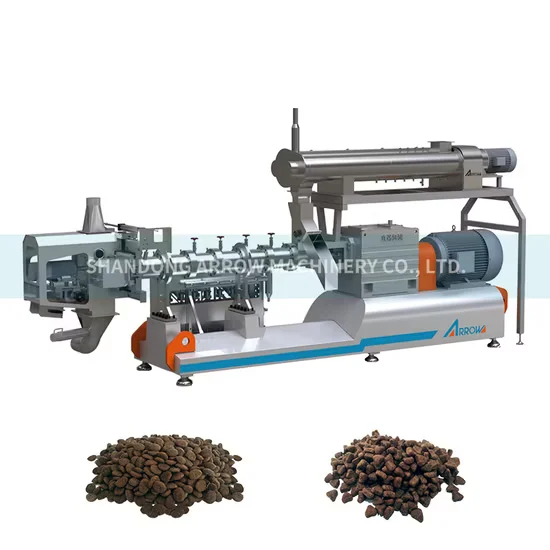 04
Dry Pet Food Production Line
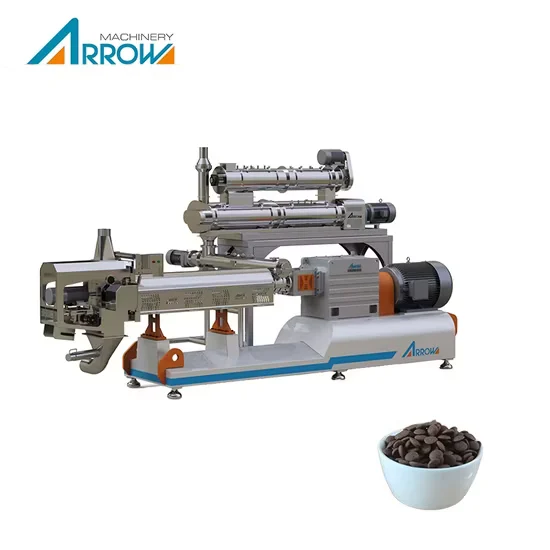
Pet Food Production Line for Dog and Cat Kibble Manufacturing
View machine detailsFurther Reading
Related extrusion process notes
· Brands & Alternatives· 7
Pet Food Extruder Choices: Arrow vs Alternative Brands
Read the article · Brands & Alternatives· 7
Enzymatic Hydrolysis Palatants Make or Buy Guide for Pet Food
Read the article
· Brands & Alternatives· 7
How to Switch from Bentonite to Starch-Based Cat Litter Production
Read the article
Configured Quotation
Send your formula and capacity for a configured line proposal
Shandong Arrow Machinery engineers review your raw materials, product shape and kg/h or t/h target, then propose a single machine or complete pet food, aquafeed or specialty feed line.
- Emailinfo@arrowextrusion.com
- WhatsApp+86 137 9316 7756
- FactoryNo. 47 Chengbohu Road, Jibei Subdistrict, Jiyang District, Jinan, Shandong, China
Request a Quote
Payment by T/T, L/C or Alibaba Trade Assurance. Scope, delivery time and commissioning support are stated in the formal quotation.