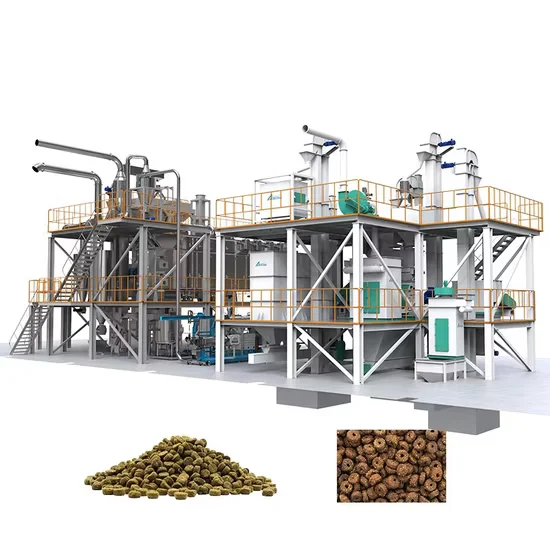
Pet owners have reached their limit with dust clouds and clogged toilets, pushing traditional clay granulation equipment toward obsolescence. As brands seek to differentiate through sustainability and cleanliness, the starch-based cat litter line has emerged as a critical investment for modern pet supply manufacturers. This shift is not merely about swapping raw materials; it requires a fundamental rethinking of thermal processing and moisture management.
The core advantage of a starch-based production system lies in its ability to deliver biodegradable, low-dust products with superior clumping performance, provided the extrusion shear and drying curves are precisely matched to the formulation. Unlike clay processing, which relies on mechanical compression, starch extrusion depends on gelatinization and structural integrity maintained through controlled thermal history.
Raw Material Behavior: Starch Formulations vs Clay Powders
Starch-based ingredients such as corn, cassava, and pea starch behave fundamentally differently from bentonite or other clay minerals. Clay granulation is primarily a physical process involving water activation and mechanical compaction. In contrast, starch processing is a thermo-mechanical transformation. The raw material must undergo gelatinization, where starch granules swell and burst under heat and shear, creating a cohesive matrix that holds its shape after exiting the die.
This difference dictates strict requirements for moisture distribution and temperature profiles. If the moisture content is too low, the starch fails to gelatinize properly, resulting in brittle pellets that shatter into dust during handling. If the moisture is too high or the temperature spike is uneven, the product may deform or stick together in the dryer.
Furthermore, starch formulations are often more sensitive to ingredient variability than clay. A slight change in the protein-to-starch ratio or the addition of plant fibers can alter the viscosity of the melt inside the barrel. This sensitivity means that a starch-based cat litter line cannot simply replicate the settings used for standard pet kibble. The process engineer must account for the specific absorption rates of the chosen botanicals to ensure consistent density and water absorption in the final product.
Extrusion & Forming: Twin-Screw vs Traditional Granulators
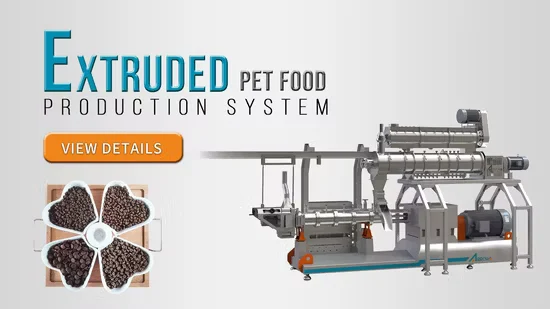
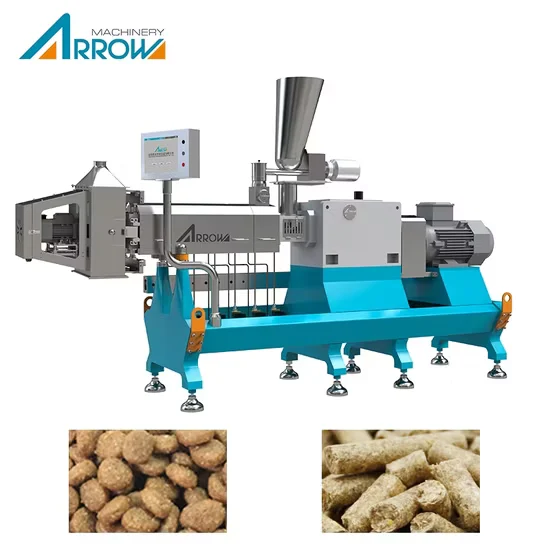
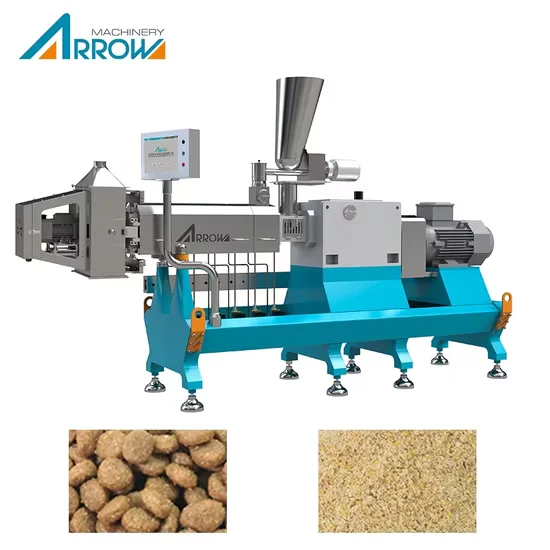
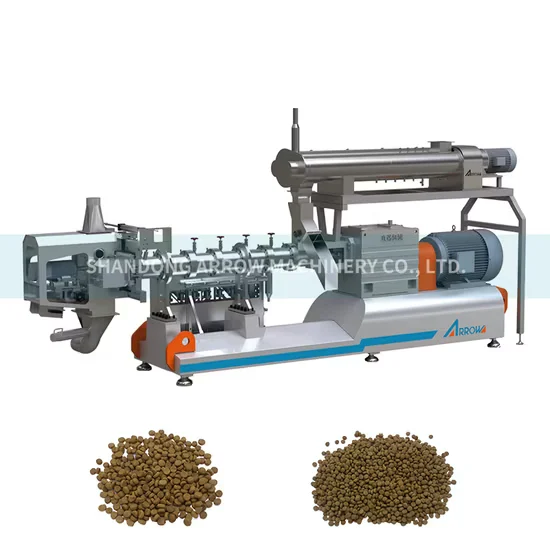
Traditional clay litter production often uses disk pelletizers or simple press rollers. These machines rely on pressure to form agglomerates. However, they lack the flexibility to handle complex, multi-ingredient starch blends. For a starch-based cat litter line, the twin-screw extruder is the central component. It provides the necessary shear force to cook the starch thoroughly while allowing precise control over the product’s internal structure.
The twin-screw configuration offers distinct advantages over single-screw systems, especially when dealing with high-fiber additives or varied particle sizes in the raw mix. The intermeshing screws create a self-wiping action that prevents material buildup and ensures uniform heating. This is crucial for maintaining the structural integrity of the litter pellets, which must be strong enough to resist breaking during packaging yet porous enough to absorb liquid rapidly.
Unlike cold extrusion machines used for certain treats, the extruder for cat litter must achieve a specific degree of cook to ensure the starch binds effectively. The screw elements can be configured to adjust the residence time and shear intensity, allowing manufacturers to produce various shapes, from long strips to small granules, without changing the entire machine setup. This flexibility is vital for brands looking to offer different product textures within the same facility.
Drying & Coating: Preserving Structure and Adding Value
Drying is often the bottleneck in any extrusion line, but it is particularly critical for starch-based litter. The goal is to remove surface and internal moisture without causing case hardening, where the outer layer dries too quickly and traps moisture inside. This trapped moisture can lead to mold growth or product crumbling later in the supply chain. A cross-flow circulation dryer provides the gentle, uniform airflow needed to reduce moisture to the target level while preserving the pellet’s porous structure.
After drying, the product may require coating to enhance functionality. While clay litter often relies on natural mineral properties, starch-based litter can benefit from added odor neutralizers or antimicrobial agents. A vacuum coating machine is ideal for applying liquid additives evenly without damaging the fragile dried pellets. For dry powder coatings, such as baking soda or scent particles, a double-drum flavoring machine ensures thorough coverage and adhesion.
The integration of these downstream systems must be balanced with the extruder’s output. If the dryer capacity is insufficient, the extruder must be throttled back, reducing overall efficiency. Therefore, when designing a starch-based cat litter line, the thermal energy requirements and airflow capacity of the drying section must be calculated based on the initial moisture content of the extrudate and the desired final moisture target.
Investment & Footprint: Turnkey Line vs Standalone Upgrades
For existing pet food manufacturers, adding a starch-based cat litter line can be a strategic expansion. Since many facilities already have grinding, mixing, and extrusion capabilities, the incremental investment may focus on specialized screw configurations, dedicated drying zones, and coating systems. This modular approach allows brands to leverage existing infrastructure while minimizing footprint expansion.
However, a turnkey solution offers better process harmony. When all components, from the raw material intake to the final packaging interface, are engineered together, the risk of mismatched capacities is eliminated. A unified engineering scope ensures that the pneumatic conveying systems, dust collection units, and control interfaces work seamlessly. This reduces the complexity of commissioning and simplifies future maintenance.
Energy consumption is another key consideration. Starch extrusion requires significant thermal energy for gelatinization, whereas clay processing is largely mechanical. However, the ability to use waste heat from other processes or optimize the dryer’s insulation can mitigate operational costs. Investors should evaluate the total cost of ownership, including utility requirements, labor for operation, and maintenance schedules, rather than focusing solely on the initial equipment price.
Frequently Asked Questions
Q: Can an existing pet food extruder be used for starch-based cat litter?
A: It depends on the screw configuration and barrel design. While some twin-screw extruders can process both, cat litter requires specific shear profiles to achieve the right density and water absorption without excessive expansion. Using a dedicated screw set or a separate line is often recommended to avoid cross-contamination and ensure optimal process stability for the unique rheology of starch-based formulations.
Q: What is the typical moisture target after drying for starch cat litter?
A: The final moisture content is usually kept low, often below 10-12%, to ensure shelf stability and prevent microbial growth. However, the exact target depends on the specific starch blend and any added hygroscopic ingredients. Precise control during the drying phase is essential to prevent case hardening, which can compromise the product’s clumping ability and structural integrity during storage and transport.
Q: How do you control dust generation in the final starch-based product?
A: Dust control starts with proper gelatinization during extrusion to create strong pellets. Downstream, efficient cooling and gentle handling minimize breakage. Screening systems remove fines before packaging, and coating processes can help bind surface particles. Additionally, optimizing the cutting mechanism at the extruder die face ensures clean cuts, reducing the creation of irregular fragments that contribute to dust in the final bag.
Q: What is the difference in energy consumption between starch and clay litter lines?
A: Starch-based lines generally consume more thermal energy due to the cooking and drying requirements of the extrusion process. Clay processing is primarily mechanical, involving grinding and pelletizing with lower heat input. However, starch lines offer higher value-added potential through functional additives and branding. Energy efficiency can be improved through heat recovery systems in the dryer and optimized motor usage in the extrusion section.
Send your starch-based formula and target capacity to receive a customized equipment configuration and factory layout. Our engineering team can discuss raw material trials and specific process requirements to ensure your production line meets both quality and efficiency goals.