Many pet treat manufacturers focus heavily on extruder throughput when scaling up dog chews production, only to find that final product quality suffers downstream. The real bottleneck often lies not in the barrel, but in the mismatch between shaping dynamics and drying kinetics.
Stable dog chews production requires more than just a powerful twin-screw extruder; it demands precise coordination between the forming die, cutting system, and drying curve. By treating extrusion and drying as a continuous thermal dialogue rather than isolated steps, factories can eliminate warping, cracking, and uneven moisture distribution. This integrated approach ensures that the physical structure formed at the die face is preserved through to the final cooling zone.
Why Dog Chews Fail During Shaping and Drying
The transition from the extruder barrel to the ambient air is a critical stress point for collagen-rich or starch-based doughs. When the material exits the die, it undergoes rapid pressure release and moisture flash-off. If the die design does not account for the specific rheology of the recipe, the product may expand unpredictably or collapse. This is particularly common in high-meat formulations where protein networks behave differently than pure starch matrices.
Once shaped, the product enters the drying phase, where most visible defects emerge. Case hardening occurs when the surface dries too quickly, forming a rigid shell that traps moisture inside. As the internal moisture eventually migrates outward, it creates internal pressure that leads to cracking or splitting. Conversely, if the drying rate is too slow, the product may sag under its own weight before the structure sets, resulting in inconsistent shapes and reduced bulk density.
These issues are not merely cosmetic; they directly impact yield and shelf stability. Uneven moisture content creates hotspots for microbial growth, while cracked pieces increase waste during packaging. Understanding these failure modes is the first step toward designing a dog chews extrusion line that prioritizes structural integrity alongside capacity.
Twin-Screw Extrusion Parameters for Precise Shaping
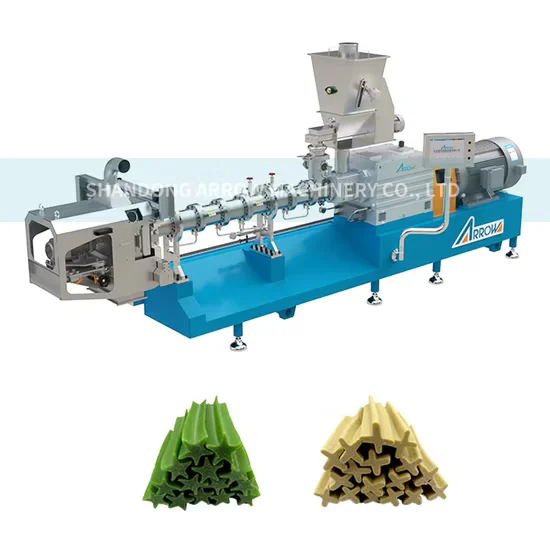
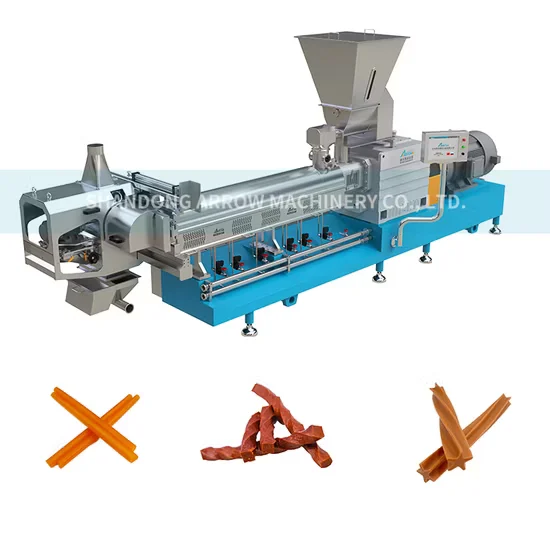
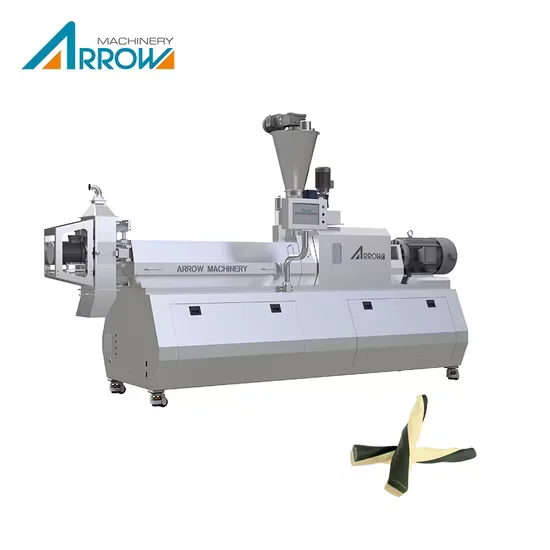
Achieving consistent shape starts with the screw configuration inside the twin-screw extruder. Unlike single-screw machines, twin-screw systems offer modular screw elements that can be arranged to control shear, mixing, and residence time. For dog chews, the goal is often to achieve sufficient cooking and homogenization without excessive expansion, unless a puffed texture is desired. Adjusting the ratio of conveying to kneading blocks allows engineers to fine-tune the dough’s viscosity before it reaches the die.
Temperature profiling across the barrel zones is equally critical. High shear generates frictional heat, which can degrade heat-sensitive ingredients like vitamins or natural colors if not managed properly. Cooling jackets on specific barrel sections help maintain target temperatures, ensuring the dough remains pliable for shaping but firm enough to hold its form upon exit. This balance is essential for recipes with varying fresh meat content, where fat acts as a lubricant and affects flow characteristics.
The die itself must be matched to the dough’s expansion potential. A die with insufficient land length may fail to provide enough backpressure, leading to irregular extrudate surfaces. On the other hand, excessive restriction can cause overheating and degradation. Modern twin-screw extruder for dog chews setups often include quick-change die heads to facilitate rapid product switches, minimizing downtime during multi-SKU production runs.
Matching the Dryer to Prevent Cracking and Moisture Spots
Drying is rarely a one-size-fits-all process. The choice between a Cross-Flow Circulation Dryer, an External Air Circulation Dryer, or a GDH Series Dryer depends on the product’s sensitivity and the required final moisture content. For delicate dog chews that are prone to cracking, a dryer with gentle, uniform airflow is preferable. Cross-flow designs allow air to pass perpendicular to the product movement, promoting even moisture removal from all sides of the pellet or chew.
The drying curve must be staged to prevent case hardening. Initial stages should remove surface moisture at lower temperatures, allowing the interior moisture to migrate outward gradually. As the product structure sets, temperature can be increased slightly to drive off bound water. Monitoring humidity levels within the drying chamber is crucial; recirculating overly humid air slows down drying efficiency, while excessively dry air can shock the product surface.
For high-value treats with complex shapes, such as twisted sticks or hollow bones, uniform wind distribution is non-negotiable. Dead zones in the dryer lead to soft spots, while high-velocity jets can cause physical deformation. Equipment selection should prioritize adjustable fan speeds and zoned temperature controls, enabling operators to tweak the profile based on daily recipe variations. This flexibility is key to maintaining consistency in a pet treats production line handling diverse SKUs.
Integrating Extrusion and Drying for Consistent Throughput
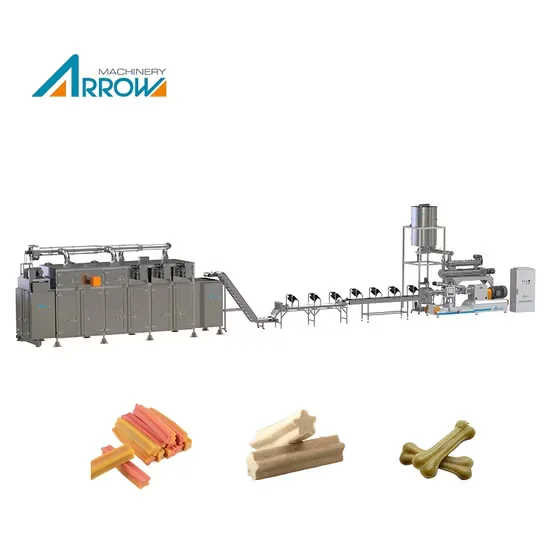
A common oversight in plant design is balancing the capacity of upstream and downstream equipment. An extruder capable of producing 500 kg/h is useless if the dryer can only handle 300 kg/h without compromising quality. Bottlenecks force operators to slow down the extruder, reducing efficiency, or overload the dryer, causing quality failures. Proper line integration involves calculating the duty points of each machine based on the specific moisture removal requirements of the product.
Layout also plays a significant role in operational efficiency. Conveying systems between the cutter and the dryer must be designed to minimize product damage and ensure even spreading on the dryer belts. Clumping at the infeed leads to uneven drying, while excessive drop heights can deform soft chews. Arrow’s engineering team focuses on these interface points, ensuring that the transition from wet extrudate to dried product is smooth and controlled.
Custom line layouts consider factory footprint and utility constraints. Whether retrofitting an existing building or designing a new facility, the spatial relationship between the extruder, dryer, and coating systems affects workflow and maintenance access. By providing a unified technical proposal, manufacturers can avoid the compatibility issues that arise when sourcing machines from multiple vendors. This holistic view supports both new installations and phased expansions, ensuring that each module integrates seamlessly into the broader process.
Frequently Asked Questions
Q: How does screw configuration affect the shaping of dog chews?
Screw configuration determines the shear and mixing intensity applied to the dough. For dense chews, lower shear elements preserve structure, while higher shear is needed for homogeneous blending of high-fat recipes. Proper configuration ensures the dough has the right viscosity to hold its shape after exiting the die, preventing deformation during subsequent handling and drying stages.
Q: What causes dog chews to crack or deform during the drying process?
Cracking is typically caused by case hardening, where the surface dries too fast, trapping internal moisture. Deformation occurs if the product is too soft when entering the dryer or if airflow is uneven. Controlling the drying curve with staged temperature and humidity settings allows moisture to migrate evenly, preserving the physical structure formed during extrusion and cutting.
Q: Can Arrow provide a complete line from extrusion to drying for dog chews?
Yes, Arrow offers integrated solutions that include twin-screw extruders, shaping dies, cutters, and drying systems like the Cross-Flow Circulation Dryer. The engineering team configures these components based on your specific recipe, capacity, and factory layout, ensuring all modules are balanced for consistent throughput and product quality throughout the entire production process.
Q: How do you ensure uniform moisture content in dried dog chews?
Uniform moisture is achieved by matching the dryer type to the product’s characteristics and optimizing the airflow distribution. Using dryers with zoned temperature control and consistent wind velocity prevents hot or cold spots. Regular monitoring of inlet and outlet moisture levels allows for real-time adjustments, ensuring every batch meets the target specification for shelf stability and texture.
Send your raw material formulation and target capacity to receive a customized technical proposal. Our engineering team will review your specific requirements to recommend the optimal configuration for your dog chews extrusion lines, including detailed layout drawings and equipment specifications tailored to your facility’s constraints.